Camp the Trans Bhutan Trail
11 days, Paro to Paro
Itinerary
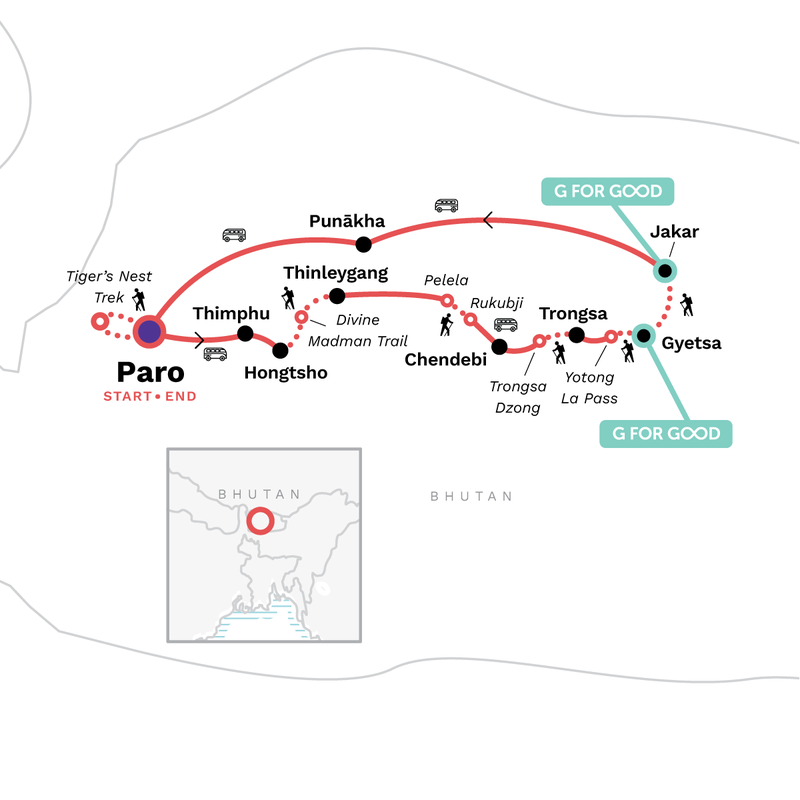
Day 1Paro/Thimphu
After arriving in Paro enjoy an included transfer to your hotel in Thimphu where you will meet the rest of the group and your local tour leader. If time permits, head out in the afternoon to Buddha Point, home to Thimphu’s most recognized landmark, the Buddha Dordenma. Then, visit the Memorial Chorten, a Tibetan-style stupa built in 1974 and one of Thimphu’s most impressive religious sites. This evening gather as a group at a local restaurant for a welcome dinner and your first chance to sample Bhutanese cuisine.
With elevations ranging between 2,248 meters (7,375 feet) and 2,648 meters (8,688 feet) above sea level, Thimphu is the fifth highest capital city in the world by altitude. It is also the only capital city in the world without any traffic lights. The city offers a unique blend of the modern world with Bhutanese tradition.
In order to have time for a visit to Buddha Point please plan to get to Bhutan by noon so that you can reach Thimpu by late afternoon and have enough time to do an orientation before going to Buddha Point. Most flights arrive to Paro in the morning.
Arrival Transfer
You will be met at the airport and transferred to the hotel to start your adventure.
Your Welcome Moment: Arrival Day and Welcome Meeting
The adventure begins today. Meet fellow travellers and learn more details about the upcoming itinerary from the CEO during today's meeting.
Buddha Point Visit
Buddha Point is home to Thimphu’s most recognized landmark, the Buddha Dordenma. Guarding the entry to the Thimphu valley, this 51-meter (167ft) gilded bronze statue is filled with 125,000 miniature statues and sits atop a three-storey base housing a chapel and thousands of donated statuettes. The statue was commissioned to mark His Majesty the Fourth King of Bhutan, Jigme Singye Wangchuck’s 60th birthday and was originally made in China before being transported to Thimphu in pieces.
The massive Buddha statue in Thimphu made of bronze and gold. Take lots of pictures - it's beautiful!
Memorial Chorten Visit
The chorten is one of the most prominent religious structures in Thimphu, and for local Bhutanese it is a popular part of their daily prayers. Watch locals walk around the Chorten, spinning the prayer wheels and meditating in this lovely and peaceful spot.
Bhutanese Group Dinner
Head out with the group to enjoy dinner at a local restaurant where you'll have your first chance to learn about and sample Bhutanese cuisine.
Accommodation
Below is an example of the hotel we may use in this city. For the actual hotel your specific departure will be using, please check your voucher.
Hotel Kisa Villa (or similar)
Meals included:
Lunch | DinnerDay 2Thimphu/Thinleygang
Today, your trek continues as you depart from Thimphu and drive to the village of Hongtsho to begin your trek. Your first major milestone is the climb to the Dochula Pass, situated at 3,100 meters (10,170 feet). Here, you will visit the 108 Stupas (Druk Wangyal Chortens), built to honor Bhutanese soldiers and the leadership of the Fourth King. On clear days, the pass offers spectacular panoramic views of the snow-capped Himalayan peaks.
After exploring the pass and the nearby Druk Wangyal Lhakhang, you will continue trekking along the "Divine Madman Trail," a historic route named after the legendary 16th-century monk Drukpa Kuenley. The path descends through lush ecological corridors into the Royal Botanical Park at Lampelri, where you will stop for a scenic picnic lunch amidst a forest famous for its many species of rhododendrons and diverse birdlife. Your day concludes with a final trek to your campsite in Thinleygang, where a locally sourced dinner will be served under the stars.
This section of the Trans Bhutan Trail connects the modern capital of Thimphu with the historic spiritual centers of the east, following a route once used by high-ranking clergy as they moved between their summer and winter residences. The Dochula Pass serves as a powerful spiritual landmark; its 108 memorial stupas are arranged in three concentric circles to symbolize spiritual completion and the removal of 108 human desires to reach enlightenment. The nearby Druk Wangyal Lhakhang temple is unique for its modern murals that blend traditional Buddhist imagery with scenes from 21st-century Bhutanese history.
As you move toward Lampelri, you enter an important biological corridor that links two of Bhutan’s national parks. This area is a haven for biodiversity, home to rare species like the red panda and over 46 varieties of rhododendron. The trail itself is steeped in the folklore of the "Divine Madman," Drukpa Kuenley, whose unconventional methods of teaching have left a lasting mark on Bhutan’s cultural and religious identity. Your day ends in the quiet valley of Thinleygang, offering a peaceful immersion into the rural landscapes that the restored trail was designed to protect and celebrate.
During the hiking portion of this trip the Trans Bhutan Trail Team will be carrying any additional belongings that travellers have with them from location to location. You will only need to worry about carrying your day pack. There isn't a specific weight limit for luggage, but keep in mind that someone will be carrying it for you along the trail. There will be a vehicle carrying the big bags to sites. Bottled water will be supplied through out the trek.
Divine Madman Trail
In an adjacent valley from the pass, join a section of the trail known as the ‘Divine Madman Trail’. You are now be following in the footsteps of the Divine Madman himself, Drukpa Kuenley, when he came to Bhutan from Tibet in the 16th century to fulfil his destiny of suppressing evil energies. Over the coming days, you will come across a number of important cultural sites and extraordinary stories related to the life of Drukpa Kuenley.
Private Vehicle
Settle in and scan the scenery from the convenience of a private vehicle.
Dochula Pass Segment of the Trans Bhutan Trail
The Dochula Pass, standing at 3,100 meters (10,170 feet) above sea level, is a spiritual and scenic gateway connecting Thimphu to the Punakha valley. It is famous for the 108 Druk Wangyal Chortens and its breathtaking 180-degree views of the Great Himalayan mountain ranges, including Mt. Gangkar Puensum, the highest unclimbed peak in the world. As you descend from the pass into the Royal Botanical Park at Lampelri, you will follow the "Divine Madman Trail," a historic route once taken by the 16th-century saint Drukpa Kuenley.
The group will hike from 2,780 meters to 1,770 meters (5,807 feet), and the trek will take approximately 7 hours to complete with a total trekking distance of 13 km (8 mi).
Accommodation
Camp Chandebji (or similar)
Meals included:
Breakfast | Lunch | DinnerDay 3Thinleygang/Chendebi
The group will transfer eastwards with packed breakfast to Pelela for the start of the hike at 3,410 metres (11,187 feet) above sea level. Arrive to Pelela Pass for a picnic lunch before starting the trek. As you descend through the meadows below Pelela, keep an eye out for the yak herder camps which can be seen scattered around the valley. Visit Rukubji’s village, famous for its unique local language called Ngyen-Kye, and have the chance to learn about it from the villagers over tea.
After visiting Rukubji, drive down to the village of Chendebi, where the group will camp for the night. A delicious organic, locally sourced dinner will be served at the campsite in the evening.
This ancient route, which runs 403 kilometres from Haa in the West of Bhutan to Trashigang in the East, dates back at least as far as the 16th century, when it would have been the only means of communication between the strategically located dzongs (fortresses) along the route. The Trail’s Garps (messengers) were quite legendary, travelling with vital messages between Dzongs at great speeds with little food or rest. Over time, the Trail came to play a major role in uniting the region’s many kingdoms, culminating in the birth of Bhutan as a nation in 1907. With the advent of Bhutan’s National Highway in the 1960s, the Trail fell into disrepair but was restored in 2019 thanks to a partnership between the Royal Bhutanese Government, the Tourism Council of Bhutan, and the Bhutan Canada Foundation. The Trail now receives visitors from across Bhutan and the world. When stopping the the village of Rukubji learn more about the local language from the locals. The dialect, called Ngyen-Kye, is a mix of other dialects from across Bhutan and even some English words, and is now only spoken by a dozen or so households.
On days when you will be hiking it’s recommended that you have your own day pack to carry during the long hiking days. In the pack you should have any daily, personal medicine you may need, sunscreen, cameras, a water bottle, and any valuables such as cash or passports.
During the trekking itself the camping crew will provide all travellers with boiled water. You can fill your water bottles with this water provided during the hiking days. But it is highly recommended that you bring your own water bottles.
Pelela Pass Segment of the Trans Bhutan Trail
At 3,407 metres (11,177 feet) above sea level, the Pelela Pass is one of Bhutan’s highest and is traditionally considered to mark the boundary between west and central Bhutan. Local craftspeople often sell fine yak-hair products at the pass. As you descend through the meadows below Pelela, keep an eye out for the yak herder camps which can be seen scattered around the valley.
The group will hike from 3320m to 2425m and it will take about 4 hours to complete with a total hiking distance of 11 km (6.8 mi).
Private Vehicle
Settle in and scan the scenery from the convenience of a private vehicle.
Rukubji’s village Lhakhang (temple) Visit
Rukubji’s village Lhakhang also known as Kuenzang Choling, is thought to have been built some 300 years ago by a Lama named Tshendhen Duelwa. Unlike most temples, it is not built on a ridge with a view out over a valley, but rather on an extended plateau and close to two rivers: the reason for this is that the Lama built the temple on top of the head of a snake-demoness which he subdued in the same location.
Accommodation
Camp Tsangkha (or similar)
Meals included:
Breakfast | Lunch | DinnerDay 4Chendebi/Trongsa
Head back to the Trans Bhutan Trail after breakfast at your camp. On today's trek, recreate the experience of past royals as you descend as a group into the steep valley below. See spectacular views of the Dzong (fortress) and cross the old cantilever bridge over the Mangde River before climbing the other side of the valley to reach Trongsa Dzong via the Western gate. After arriving to our hotel, the rest of the day is yours to relax and explore before joining back together for dinner at a local restaurant in the early evening.
Trongsa is Bhutan’s geographical center point and is very closely linked to the Bhutanese Royal Family: the first two hereditary Kings ruled from Trongsa Dzong (fortress) and the crown prince still traditionally serves as the Penlop (Governor) of Trongsa before acceding to the throne. The Trans Bhutan Trail still passes directly through the middle of the city of Trongsa and, in centuries gone by, the trail would actually have passed right through Trongsa Dzong itself.
On days when you will be hiking it’s recommended that you have your own day pack to carry during the long hiking days. In the pack you should have any daily, personal medicine you may need, sunscreen, cameras, a water bottle, and any valuables such as cash or passports.
During the trekking itself the camping crew will provide all travellers with boiled water. You can fill your water bottles with this water provided during the hiking days. But it is highly recommended that you bring your own water bottles.
Chorten (stupa) Visit in Chendebi
At Chendebji, visit the Chorten (stupa), which is built at on the point on which it is believed that the three ridges and the three edges of the sky meet. The Chorten was built by Lam Ngedup Tshering Wangchuk in order to subdue a local demoness, Nyala Dudm, and bring peace to the Chendebji Valley.
Trongsa Viewpoint to Trongsa Fortress Trek
Trongsa is Bhutan’s geographical center point and is very closely linked to the Bhutanese Royal Family: the first two hereditary Kings ruled from Trongsa Dzong (fortress) and the crown prince still traditionally serves as the Penlop (Governor) of Trongsa before acceding to the throne. The Trans Bhutan Trail still passes directly through the middle of the city of Trongsa and, in centuries gone by, the trail would actually have passed right through Trongsa Dzong itself. Today you will recreate the experience of arriving at this powerful city on foot in the same way the garps (messengers) would have done centuries ago, as you descend into the steep valley below the viewpoint, enjoying spectacular views of the Dzong (fortress) on the opposite side. At the bottom of the valley, you will cross the old cantilever bridge over the Mangde River before heading up the other side of the valley.
The group will hike from 2276m to 2200m and it will take about 2 hours total with a final hiking distance of 3 km.
Free Time
The rest of the afternoon is yours to explore the beauty of Trongsa.
Accommodation
Yangkhil Resort (or similar)
Meals included:
Breakfast | Lunch | DinnerDay 5Trongsa
Devour a quick breakfast this morning before heading out for a tour of Trongsa Dzong (fortress), first built as a small meditation room in 1541. Visit a selection of the Dzong’s 23 lhakhangs (temples), before heading to the Trongsa Ta Dzong (watchtower), which now houses the interesting Royal Heritage Museum. The remainder of the day will be at leisure to explore Trongsa at your own pace.
Trongsa Dzong (fortress) Visit
Trongsa Dzong (fortress) was first built by Ngagi Wangchuck as a small meditation room in 1541, after he discovered self-manifested hoof-prints belonging to the deity Pelden Lhamo on the same spot. Trongsa, which means ‘new village’ in the local dialect, soon spring up around the site. The Dzong (fortress) was built in its present form in 1644 and then enlarged again at the end of the 17th century. It is home to some 450 district monks who spend their winters in Trongsa and their summers in Bumthang.
Free Time
Spend the rest of your time here exploring Trongsa at your own pace.
Accommodation
Yangkhil Resort (or similar)
Meals included:
Breakfast | Lunch | DinnerDay 6Trongsa/Gyetsa
Wave farewell to Trongsa today and head back out on the Trail for some more hiking. Drive to Yotong La Pass to join the trail. Trek through a stretch of dense forest and cross through meadows, through open forest until the trail reaches the Gyetsa River. Arrive at Gyatsa Youth Community Cafe after lunch and enjoy a hands-on cultural activity with the youth. Once the group arrives at camp in Gyetsa you’ll be able to enjoy a hot shower and a locally-sourced organic dinner at the campsite.
On days when you will be hiking it’s recommended that you have your own day pack to carry during the long hiking days. In the pack you should have any daily, personal medicine you may need, sunscreen, cameras, a water bottle, and any valuables such as cash or passports.
During the trekking itself the camping crew will provide all travellers with boiled water. You can fill your water bottles with this water provided during the hiking days. But it is highly recommended that you bring your own water bottles.
Private Vehicle
Settle in and scan the scenery from the convenience of a private vehicle.
Trans Bhutan Trail Yotong La Pass to Gyetsa
Today’s portion of the Trail begins at the majestic Yotong La pass, a high mountain gap often shrouded in mist and adorned with fluttering prayer flags. This trek is particularly rewarding for birdwatchers, as the descent crosses through several vibrant ecological zones, starting with the silence of high-alpine firs and moss-draped rhododendrons. From the pass, the Trail cuts through dense, ancient forest where the path can feel springy underfoot or slick with mountain dew. From Yotong La, the Trail descends steadily through alpine meadows and open forest until the landscape meets the Gyetsa River. The last stretch for today is a pleasant riverside walk, where the terrain finally flattens into an easy stroll towards the traditional stone houses of Gyetsa.
The group will hike from 3425m at Yotong La Pass to 2891m and will take at least 5 hours for a total distance of 9.5 km.
Accommodation
Camp Gyetsa (or similar)
Meals included:
Breakfast | Lunch | DinnerDay 7Gyetsa to Bumthang
Today after breakfast the group will trek through the most historic section of the trail. This section was used by the royal family when they travelled between their winter and summer residences. You’ll travel through Kikila Pass before descending into the Bumthang Valley. We’ll stop along the way for a picnic lunch, enjoying the scenery.
Once you arrive in Jakar, visit the majestic Jakar Dzong (fortress), also known as the ‘Castle of the White Bird’. Observe unique features like its fifty-meter utse (tower) and a sheltered passage with two parallel walls, interconnected by fortified towers, which guaranteed the fortress’s inhabitants access to water during a siege. Visit the Red Panda Brewery after for a well-deserved rest. This evening, enjoy a special experience as you settle into your local homestay accommodation. Spend the evening with a few of your fellow travelers in the home of a local Bhutanese family who will be your hosts for the evening. Share a meal and exchange stories while learning about what life is like for your local hosts.
On days when you will be hiking it’s recommended that you have your own day pack to carry during the long hiking days. In the pack you should have any daily, personal medicine you may need, sunscreen, cameras, a water bottle, and any valuables such as cash or passports.
During the trekking itself the camping crew will provide all travellers with boiled water. You can fill your water bottles with this water provided during the hiking days. But it is highly recommended that you bring your own water bottles.
Trans Bhutan Trail Gyetsa to Jakar
Trek through the most historic section of the trail which the royal family used when they travelled between their winter and summer residences. The trail passes through the Kikila Pass and the owl trek and then gently descends into the Bumthang Valley.
The group will hike from 2891m to 2574m and it should take about 7 hours for a total distance of 17.5 km.
Jakar Dzong Fortress Visit
Jakar Dzong (fortress), is also known as the ‘Castle of the White Bird’. This huge structure dominates the Chamkar Valley and the town below it. It was built in 1549 by the Tibetan Lam Nagi Wangchuk and was Eastern Bhutan’s main defensive stronghold. Later, it became the seat of the First King of Bhutan. Unique features include its fifty-meter utse (tower) and a sheltered passage with two parallel walls, interconnected by fortified towers, which guaranteed the fortress’s inhabitants access to water during a siege.
Bumthang Brewery Visit
Bumthang Brewery, producers of Bhutan’s celebrated Red Panda Beer. Nearby is Bhutan’s only commercial cheese factory. Both the brewery and the cheese factory are legacies of a Swiss-run development project called Swiss Farm, which introduced distinctive European farming and production techniques into the Bumthang area.
Your G for Good Moment: Dorjibee Weaving Centre
Visit the wonderful Dorjibi Weaving Centre, a cooperative that empowers local women in Bhutan by providing them a platform to preserve their traditional crafts while also supporting them to earn an income for themselves. Join this hands-on experience to learn about local weaving directly from the women artisans.
Your Local Living Moment: Bhutanese Homestay
Settle into your local homestay accommodation. Spend the evening with a few of your fellow travellers in the home of a local Bhutanese family who will be your hosts for the evening. Share a meal and exchange stories while learning about what life is like for your local hosts.
Because of group size three rooms in each home will be available and the group will be separated between those rooms.
Accommodation
DorjiBee Village Homestay (or similar)
Meals included:
Breakfast | Lunch | DinnerDay 8Bumthang to Punākha
Enjoy breakfast at your homestay before transferring back to the charming town of Punakha for a day of exploring. You’ll stop for lunch en route and then visit the Bazam (bridge) just across the river from Punakha Dzong (fortress). In order to cross the bridge on foot you must be wearing formal Bhutanese dress, including a gho for men and a kora for women. On the other side head out on a tour of the Dzong (fortress).
In the evening, enjoy another homestay experience with local Bhutanese families. Tuck into a delicious homemade meal and rest up for another incredible day ahead
Private Vehicle
Settle in and scan the scenery from the convenience of a private vehicle.
Punakha Dzong Visit
Visit Punakha Dzong, the winter seat of the Je Khenpo and the Monk Body, remarkably located between the rivers of the Mo (female) Chu and Pho (male) Chu. It is the second oldest and second largest dzong (fortress) in Bhutan and one of its most majestic structures, housing many sacred relics. It is also the winter capital of the Je Khenpo (chief abbot). Built by Zhabdrung Ngawang Namgyal in around 1637. Arguably, it is the most beautiful Dzong in the country. The Dzong guards Bhutan’s most treasured relic, the Rangjung Kharsapani, an image of Chenresig kept away from the public in the utse (tower). It has survived Tibetan invasions, numerous fires, floods and a glacial lake burst. The Dzong served as the capital and seat of the Bhutanese Government until the early 1950s; and the coronation of the His Majesty the First Druk, Gyalpo Ugyen Wangchuck, took place here.
Your Local Living Moment: Bhutanese Homestay
Settle into your local homestay accommodation. Spend the evening with a few of your fellow travellers in the home of a local Bhutanese family who will be your hosts for the evening. Share a meal and exchange stories while learning about what life is like for your local hosts.
Because of group size three rooms in each home will be available and the group will be separated between those rooms.
Accommodation
Phuentsho Choeling Heritage (or similar)
Meals included:
Breakfast | Lunch | DinnerDay 9Punākha/Paro
Today after breakfast, the group will transfer to Paro where you’ll check into the hotel and have lunch. Then , it’s time to head out and see some of Paro’s most popular sites. Visit the Ta Dzong or ‘watchtower’ which is now Bhutan’s National Museum, home to a number of exhibitions including sculpture, painting and artifacts depicting Bhutan’s magical past. Then, continue to the stunning Paro Rinpung Dzong (fortress), meaning ‘Fortress on a Heap of Jewels’, This evening indulge in some delicious dinner with your CEO and fellow travellers.
Private Vehicle
Settle in and scan the scenery from the convenience of a private vehicle.
Paro’s Ta Dzong Visit
Paro’s Ta Dzong or ‘watchtower’ was originally built in 1649 to protect Paro Dzong from the Tibetan military. In 1968, Ta Dzong became Bhutan’s National Museum, and is now home to a number of exhibitions including sculpture, painting and artifacts depicting Bhutan’s magical past.
Paro Rinpung Dzong Visit
Visit Paro Rinpung Dzong, which means ‘Fortress on a Heap of Jewels”. The original construction of this dzong is believed to have been completed in 1458 and it was restored to its present glory by His Majesty the Third of Bhutan, King Jigme Dorji Wangchuck, to mark his royal wedding in 1951.
Accommodation
Metta Resort (or similar)
Meals included:
Breakfast | Lunch | DinnerDay 10Paro
Fill up on breakfast before heading northwest out of Paro for a visit to the iconic Taktshang Goemba, more commonly known as the ‘Tiger’s Nest Monastery’. Precariously perched on a sheer cliff face 900 metres (2,950 feet) above the Paro Valley floor, the Tiger’s Nest is undoubtedly Bhutan’s most famous religious building. The trek offers spectacular views from the ridge and passes a small chorten, a basic monastery, and a waterfall on its way. Once you have reached the Tiger’s Nest, you will have a chance to visit the cave where Guru Rinpoche meditated, as well as the extensive network of Lhakhangs (chapels) which house images, murals, chortens, and a holy spring.
If time allows, make a quick trip to Machig-phu Lhakhang (temple) on the way back down to the access road. The rest of the afternoon will be at leisure to relax at your hotel or to explore Paro on your own, before enjoying a last dinner with your group at a local restaurant to celebrate the trip!
Free Time
Spend the afternoon and early evening exploring Paro on your last full day in this Bhutanese city.
Taktsang (Tiger’s Nest) & Monastery Hike
Hike up to the Taktsang monastery (Tiger’s Nest); containing 13 holy relics, it's considered one of the most venerated pilgrim sites of the Himalayan world. It is also where Guru Padmasambhava is said to have landed on the back of a tigress in the 8th century. Take in the stunning views en route and the incredible vista from this monastery, which clings to the rock towering 2,953m above the valley.
The group will hike from 2400m elevation and reach 3100m at the Taktsang Monastery before returning back to 2400m in the same day. The climb should take around 6 hours for a total distance of 7 km.
Transport
Settle in and scan the scenery as you journey to and from the Tiger’s Nest Monastery Hike from Paro.
Accommodation
Metta Resort (or similar)
Meals included:
Breakfast | Lunch | DinnerDay 11Paro
Enjoy one last breakfast before being transferred from your hotel to the airport for your flight home. While at the airport, opt to experience a cultural art class at the social enterprise, VAST, a G Adventures-supported studio.
Private Vehicle
Settle in and scan the scenery from the convenience of a private vehicle.
Optional Activities - Day 11 HideShow
VAST Airport Experience
Turn waiting at the airport into an art class! Visit the hands-on art experience at VAST (Voluntary Artists’ Studio Thimphu) Happy Brush Activity Corner in the Paro Airport. The initiative works to nurture the artistic potential of Bhutanese youth by involving youth in community service, while empowering them to explore art as a viable and fulfilling career path. Through different hands-on activities, like painting a traditional mask featured in the festivals and folklore of Bhutan.