Hiking the Alpe-Adria Trail, Alps to the Adriatic
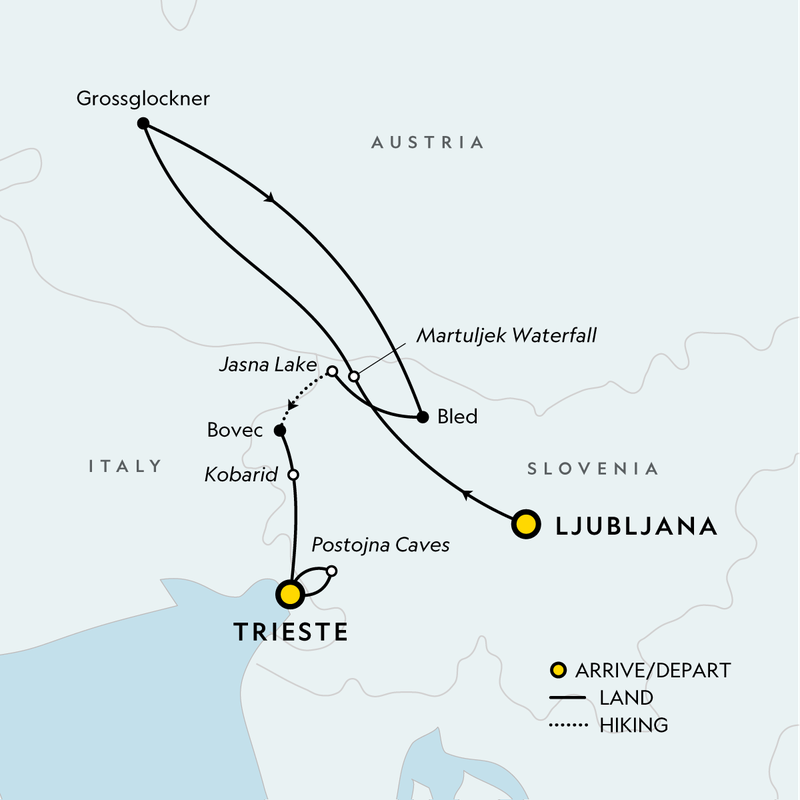
9 days, Ljubljana to Trieste
When arranging your transportation, such as flights, please take into consideration the below time restrictions for joining and departing from your group. With these times, we have taken into account travel time to/from the airport in the given destination and required time for check-in or baggage collection/immigration.
Itinerary
Day 1Ljubljana
Welcome to the elegant capital of Slovenia. Your expedition begins in Ljubljana, where you will be met at the airport and transferred to your hotel. Settle in before setting out on a walking tour to admire the intricate clock tower and the legendary Dragon Bridge. Take the funicular up to the medieval Ljubljana Castle, perched high above the red-tiled roofs. Later, meet your National Geographic Expedition Leader and National Geographic Expedition Expert for a presentation on the landscapes ahead, then gather for a welcome dinner featuring a first taste of refined Slovenian cuisine as the city lights begin to glitter below.
Your Welcome Moment: Welcome Moment - Meet Your Expedition Leader and Group
Your opportunity to meet your Expedition Leader and fellow travellers, and learn more about your tour. Don't forget to see the notice in the lobby (or ask reception) for the official time and place to meet up with the group on the morning of day two.
Guided Ljubljana Tour
Enjoy a guided walk through a city where emerald waters reflect the legacy of grand architects and Alpine peaks frame every horizon. From the dragon-guarded bridges of the Old Town to the quiet majesty of a hilltop castle, connect with the refined soul of Slovenia.
Ljubljana Castle Dinner
Taking the funicular up to Ljubljana Castle for dinner is the ultimate "ascent into elegance", abridge between Ljubljana’s vibrant street life and its noble history. Sit down in the warmth of the courtyard for an evening spent within ancient granite walls while soaking in the modern cityscape below, and the local culinary creations on your plate.
Meals included:
DinnerDay 2Ljubljana/Heiligenblut
The expedition starts this morning with a visit to a local social enterprise, where a hands-on upcycling workshop offers a thought-provoking introduction to the circular economy of Slovenia and the communities building it. Continue into the spectacular alpine landscape of Gozd Martuljek. Here you start your hike as the mist-laden trail leads toward the thundering Martuljek Waterfalls — a dramatic curtain of white water framed by dense forest and granite peaks. A light lunch at a rustic mountain hut provides a moment of warmth before continuing your hike. Next, board your coach for a drive across the Wurzen Pass into Austria. The village of Heiligenblut awaits, its slender church spire pointing skyward against the mighty silhouette of the Grossglockner — a fitting end to a day of elemental beauty.
Trail Detail: 5 km (3 mi) | 3h | + 200 m (660 ft) / - 200 m (660 ft) ascent/descent | Moderate
Visit Smetumet Workshop
Smetumet is a social enterprise and upcycling initiative that reduces waste by transforming trash into unique, usable products like bags and gifts. They promote sustainability and circular economy principles through creative workshops, awareness campaigns, and community engagement, aiming for a waste-free, greener future.
Private Vehicle
Settle in and scan the scenery from the convenience of a private vehicle.
Hike to Martuljek Waterfalls and Hut Lunch
This loop-trail hike begins with the low-frequency roar of the stream, moves through the physical effort of the forest climb, and ends with the absolute silence of the Jasenje Meadow. Your hike pauses for lunch at the legendary Ingo’s Hut (Brunarica pri Ingotu), in one of the most dramatic "amphitheaters" of the Julian Alps.
Private Vehicle
Settle in and scan the scenery from the convenience of a private vehicle.
Meals included:
Breakfast | Lunch | DinnerDay 3Heiligenblut
A short drive brings you to a stunning viewpoint for a cinematic look at the Pasterze Glacier. Begin your hike along the Pasterze trail portion with a steep descent through the alpine tundra to the Margaritzen dam before ascending back to the Glocknerhaus. The air is crisp and thin here, offering a sense of total immersion in the High Tauern range. After a hearty lunch at a mountain hut, return to Heiligenblut by private coach. Spend a leisurely afternoon soaking in the village views before gathering for dinner at your hotel, reflecting on a day spent among the giants of the Alps.
Trail Detail: 6 km (3.7 mi) | 4h | + 171 m (561 ft) / - 400 m (1,312 ft) ascent/descent | Moderate
Private Vehicle
Settle in and scan the scenery from the convenience of a private vehicle.
Kaiser-Franz-Josefs-Höhe Viewpoint
The view from Kaiser-Franz-Josefs-Höhe (2,369m) is widely considered the most dramatic alpine vista in Austria. It is a place of stark contrasts: the vertical, dark granite of the Grossglockner (3,798m) stands directly opposite the sprawling, blue-white river of the Pasterze Glacier.
Hiking the Pasterze Trail to Glocknerhaus
Hiking the trail from the Pasterze Glacier to the Margaritzen Dam and ascending to the Glocknerhaus is one of the most visually staggering experiences in the Austrian Alps. It places you at the very feet of the Grossglockner (3,798 m), Austria’s highest peak. This hike is a masterclass in Alpine geology. It takes you from the raw, prehistoric world of the glacier to the engineered precision of the dams, finally ending at the warmth of a traditional mountain hut for lunch
Private Vehicle
Settle in and scan the scenery from the convenience of a private vehicle.
Meals included:
Breakfast | Lunch | DinnerDay 4Heiligenblut/Bled
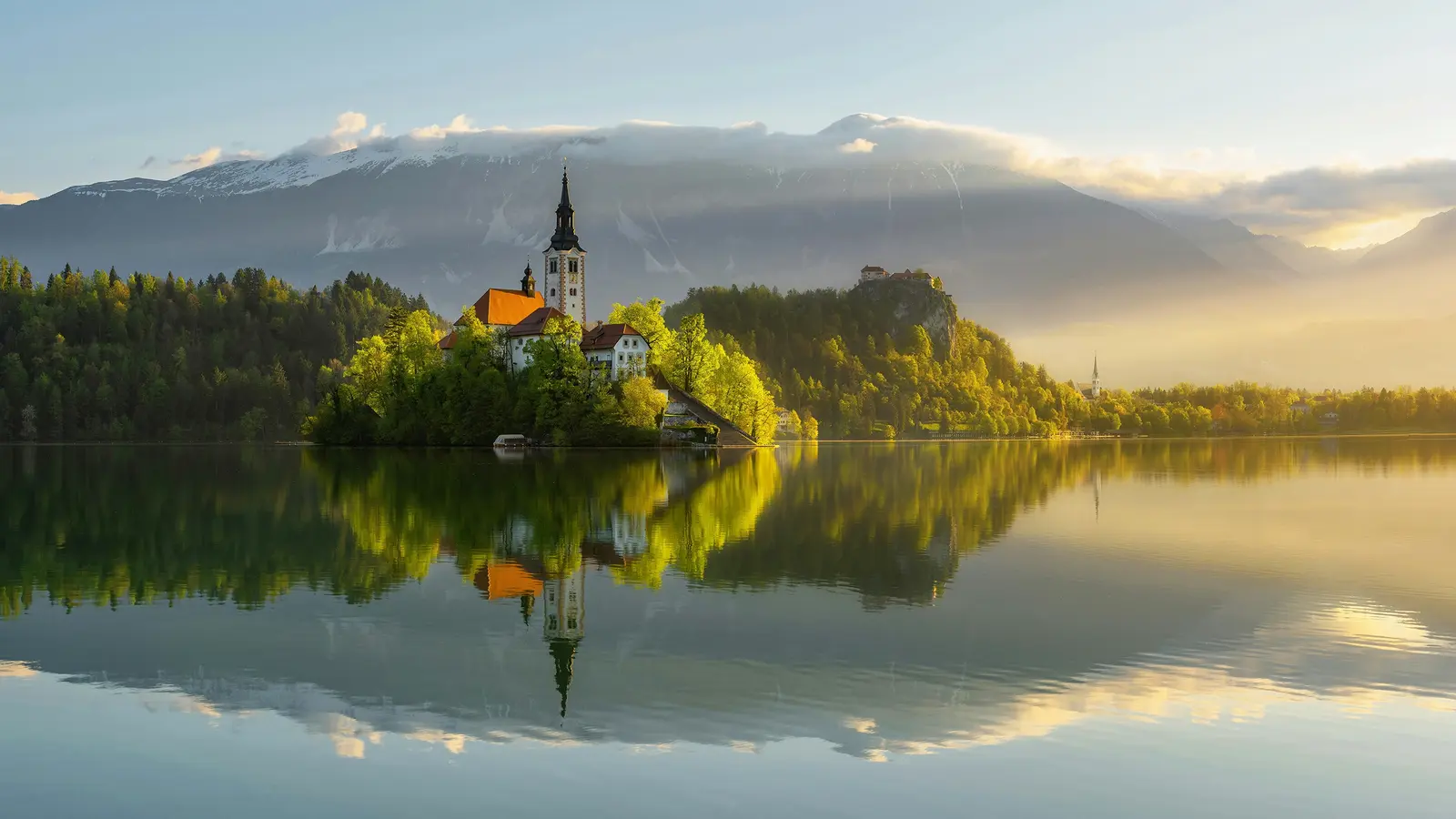
Travel to Erlacherhaus for a morning break before hiking up to Oswalder Bockhütte, where you have lunch at this iconic hut. Follow the ridgeline through a biosphere reserve, taking in the expansive mountain vistas that stretch toward the horizon. Descend by cable car and board your coach for the journey back into Slovenia to the shores of Lake Bled. Arrive at this fairytale destination, where an island church sits reflected in the still, turquoise water. The evening is yours to explore the lakeside and enjoy the gentle mountain breeze.
Trail Detail: 6 km (3.7 mi) | 4h | + 400 m (1,312 ft) / - 130 m (430 ft) ascent/descent | Challenging
Private Vehicle
Settle in and scan the scenery from the convenience of a private vehicle.
Hike to Oswalder Bockhütte and Sankt Oswald
The air at the Erlacherhaus is filled with the scent of sun-warmed larch needles. You’ll start on Path 13 of the Alpe-Adria-Trail, winding upward through ancient stone pine forests where marmots are frequently seen sunning themselves on the boulders. After a steady 45-minute climb, the forest gives way to vast alpine pastures where you find the massive terrace of the hut waiting. Next, Speichersee Brunnach is a brilliant turquoise mirror and offers wooden lounge chairs perfect for a pre-descent siesta.
Private Vehicle
Settle in and scan the scenery from the convenience of a private vehicle.
Orientation Walk Around Lake Bled
Begin your walk at the lakeside promenade near your hotel. This is home to the famous Bled Heart photo spot, which looks particularly striking today against the backdrop of the misty lake. Bled Castle dominates the north shore from its 130-meter cliff, the castle is accessible via a steep, winding path from the St. Martin’s Church area. As you round the bend toward Vila Bled (Tito’s former summer residence), the walk becomes quieter and more shaded.
Meals included:
Breakfast | LunchDay 5Bled/Bovec
The morning begins on the still waters of Lake Bled, crossing by traditional Pletna boat to the island church at its centre — a place of pilgrimage for centuries, reached by climbing 99 stone stairs worn smooth by generations of visitors. As you travel by coach to the trail head, the landscape shifts dramatically as you arrive at the gorgeous Jasna Lake and the Pišnica Valley to start your hike. Your hike is on the northern side of the Vršič Pass, nestled in the forest before the summit pass is the Russian Chapel — a wooden sanctuary built deep in the forest by prisoners of war — which stands as one of the most poignant and unexpected sights on the entire route. After lunch at a mountain hut, board your vehicle for a drive along the hairpin bends of the Vršič Pass, the limestone walls glowing amber in the afternoon light as the valley drops toward Bovec and the luminous waters of the Soča.
Trail Detail: 6 km (5.6 mi) | 4h | + 310 m (1,020 ft) / - 0 m (0 ft) ascent/descent | Moderate
Bled Lake Pletna Boat Ride
Board your traditional boat for a ride to Bled Island. Unlike a motorboat, the only sound is the rhythmic creak-slap of the oars. Disembark on the island and the "sightseeing" turns into a series of local rituals: The most recognisable symbol of the island is the Church of the Mother. Inside the church, pull the rope to ring the bell three times. Legend says it will grant one wish, provided you believe in the "Lady of the Lake. Don't leave without visiting the island’s boutique bakery.
Private Vehicle
Settle in and scan the scenery from the convenience of a private vehicle.
Hike Jasna Lake to the Russian Chapel
The hike from Lake Jasna, often referred to locally as the gateway to the mountains, to the Russian Chapel is one of the most poignant and visually stunning segments of Stage 23 of the Alpe-Adria-Trail. It is a narrative of beauty and tragedy and a transition from the leisure of the lakeshore to the rugged, historic heart of the Julian Alps.
Private Vehicle
Settle in and scan the scenery from the convenience of a private vehicle.
Meals included:
Breakfast | Lunch | DinnerDay 6Bovec
The Soča River earns its reputation today — a thread of impossible turquoise cutting through the protected wilderness of Triglav National Park, its colour so vivid it barely seems real. The trail follows the gorge and crosses suspension bridges and narrows where the river has carved deep, crystalline pools into white limestone over millennia. End your hike today back in the village of Bovec. The afternoon brings a change of pace at a local eco-farm, where an artisanal cheese tasting introduces the rich dairy traditions of the Bovec valley — fresh yogurts and aged rounds are served with the unhurried warmth of a family who has farmed these alpine pastures for generations. A regional lunch follows before a free afternoon to soak in the mountain air of the Soča Valley.
Trail Detail: 10 km (6.2 mi) | 4h | + 100 m (328 ft) / - 100 m (328 ft) ascent/descent | Easy
Hike the River the Soča Trail
Your hike begins just past the village of Soča at the entrance to the Great Gorge, this is the "Instagram" shot of Slovenia. The river is squeezed into a limestone canyon only a few meters wide but 15 meters deep. A few kilometers in, you’ll reach the spot where the Lepenjica River joins the Soča. The trail enters a more wooded area as you approach the Kršovec Gorge. As you approach the end of the trail, the narrow Trenta Valley suddenly "breaks open" into the wide, sun-drenched Bovec Basin.
Private Vehicle
Settle in and scan the scenery from the convenience of a private vehicle.
Your Foodie Moment: Cheese Tasting and Lunch at an Eco Farm
A visit to Škander Farm is a masterclass in "slow food" before the term became a marketing cliché. Located just a stone's throw from the emerald Soča River, this eco-farm is one of the few places left dedicated to the Bovška ovca (Bovec sheep), an autochthonous breed that has survived in these harsh Alpine conditions for centuries. You are tasting the landscape of the Soča Valley through the biology of a single, hardy breed of sheep. It’s unpretentious, deeply authentic experience.
Meals included:
Breakfast | LunchDay 7Bovec/Trieste
Travel to Kobarid for a visit to the Kobarid Museum. Join the museum curator for a private visit, hearing the gripping stories of the soldiers who fought on the Isonzo Front during World War I. Next, hike to the Kozjak Waterfall, tucked away in a mossy limestone cave that resembles a natural cathedral. After feeling the cool spray of the falls, continue to the Smartno region for a celebratory lunch and wine tasting amidst the rolling vineyards. Cross the border into Italy and settle into the grand port city of Trieste for a free evening.
Trail Detail: 3 km (2 mi) | 2h | Minimal elevation change | Easy
Private Vehicle
Settle in and scan the scenery from the convenience of a private vehicle.
Signature Moment: Private Visit to the Kobarid Museum with a curator of the museum.
A private visit to the Kobarid Museum is a lesson in empathy. With a curator as your guide, the rusted wire, gas masks, and mountain maps transform into the stories of individual men caught in a global storm. This is a profound descent into the "humanity of the trenches." While many war museums focus on strategies and triumphs, Kobarid is world-renowned as a "museum of man and his plight."
Hike Out and Back to Kozjak Waterfall
Your walk begins by crossing the famous Napoleon Bridge. Originally built in 1750 (and used by Napoleon’s troops), the current stone arch offers one of the most iconic views of the Soča River. The hike from Kobarid to Kozjak Waterfall is widely considered the "gold standard" of short Slovenian treks. It is less of a grueling expedition and more of a curated gallery walk through the best of the Soča Valley’s natural and wartime history.
Private Vehicle
Settle in and scan the scenery from the convenience of a private vehicle.
Your Foodie Moment: Tasting and Lunch at Edi Simčič Winery
A visit to Edi Simčič is a masterclass in heritage and ambition. Today, the third generation—Jure and Jakob—are at the helm, bringing modern precision while maintaining the "Old World" soul. A tasting at Edi Simčič is an intellectual exercise in power and elegance. These are not "quaffing" wines; they are architectural. Lunch here is an intimate extension of the Simčič hospitality. It is served "family-style," often in a room that looks out over the very vineyards that produced the wine in your glass.
Private Vehicle
Settle in and scan the scenery from the convenience of a private vehicle.
Meals included:
Breakfast | LunchDay 8Trieste
The final day of the trail begins before dawn with the expedition's most extraordinary moment — private, before-hours access to the Postojna Caves. Board an open-air electric train with a cave expert, zipping through narrow tunnels into vast subterranean galleries where stalactites hang like chandeliers from cathedral ceilings, their formations built over millions of years. Next, drive to the trail head at Krvavi Potok to hike the penultimate stage of the Alpe-Adria trail via Val Rosandra to Bagnoli della Rosandra. This hike marks the final descent through the Val Rosandra — a limestone gorge that drops from the karst plateau toward the sea — arriving in a local village for lunch as the Adriatic shimmers in the distance. Board your vehicle and return to Trieste where you gather for a farewell dinner, toasting the alpine peaks left far behind.
Trail Detail: 8 km (5 mi) | 3h | + 70 m (230 ft) / - 370 m (1,214 ft) ascent/descent | Moderate
Private Vehicle
Private Coach day trip from Trieste Postojna Cave/Krvavi Potok/last stage Adria
Signature Moment: Private, Before-Hours Postojna Caves Visit
A private, before-hours visit to Postojna Cave with a specialised expert is the ultimate "backstage pass" to the underworld. While the general public waits for the mid-morning rush, you enter early, when the only sound is the rhythmic heartbeat of the cave—the slow, persistent dripping of water that has been carving this karst masterpiece for millions of years.
Hike the Penultimate Stage 36 of the Alpe-Adria-Trail
Hiking the penultimate stage 36 of the Alpe-Adria-Trail is a masterclass in geographical drama. Start in Krvavi Potok you begin in the high, silent limestone plateau of the Slovenian Karst. As you cross into Italy near Basovizza, the architecture shifts subtly and the trail joins the Giordano Cottur Bike Path (the old Austro-Hungarian railway line). Later, descend into the rugged, sun-drenched Italian canyon of Val Rosandra. This is the "crown jewel" of the hike. You leave the flat railway path and dive into a deep, limestone canyon that looks like a miniature version of the Grand Canyon, but with a Mediterranean soul.
Private Vehicle
Settle in and scan the scenery from the convenience of a private vehicle.
Private Vehicle
Settle in and scan the scenery from the convenience of a private vehicle.
Meals included:
Breakfast | Lunch | DinnerDay 9Trieste
After a final breakfast by the sea, take a moment to reflect on the ancient trails and emerald waters witnessed on your expedition. Transfer is provided to the airport where your expedition concludes. Carrying with you the spirit of the mountains and the enduring legends of the Adriatic coast.
Departure Transfer
You will be met at your hotel and transferred to the airport at the end of your adventure.