Serengeti & Ngorongoro Crater Safari
4 days, From Arusha to Arusha
Serengeti & Ngorongoro Crater Safari
There are no departure dates currently available for the rest of this season. Some tours only run during parts of the year.
Please Contact Us to inquire about dates for next season, or to discuss other tour options.
Please Contact Us to inquire about dates for next season, or to discuss other tour options.
Tour Overview
Your adventure snapshot
Trip CodeTDTSNC
Days4
FromArusha
ToArusha
Countries VisitedTanzania
Countries VisitedTanzania
The perfect private safari for the independent traveller. Tour the best-known wildlife parks in Tanzania in search of the "big five" — lion, leopard, rhino, elephant, and buffalo. Experience breathtaking views of East Africa's Great Rift Valley, the wide-open and endless Serengeti plains, and the wildlife haven of the Ngorongoro Crater. See phenomenal wildlife in its natural habitat while enjoying your evenings in comfortable accommodations. This is Tanzania at its best!Is this tour for me?
Travel Style
Classic
Service Level
Upgraded
Physical Grading
2 - Light
Trip Type
Independent Travel
Age Requirement
Trees for Days
Ripple Score
There are no departure dates currently available for the rest of this season. Some tours only run during parts of the year.
Please Contact Us to inquire about dates for next season, or to discuss other tour options.
Please Contact Us to inquire about dates for next season, or to discuss other tour options.
What’s included
- AccommodationMobile tented camp (2 nts), permanent tented camp (1 nt).
- Meals Included3 breakfasts, 4 lunches, 3 dinners
- Transport7-seat 4x4 safari vehicle.
The Extras
- Your flightCall us, we can help.
- Meal BudgetAllow USD50-65 for meals not included.

Dates & Availability
The countdown starts here
There are no departure dates currently available for the rest of this season. Some tours only run during parts of the year.
Please Contact Us to inquire about dates for next season, or to discuss other tour options.
Please Contact Us to inquire about dates for next season, or to discuss other tour options.
Frequently asked questions
All the A's to your Q's
Your G for Good Moment: Mto wa Mbu Community Visit and Lunch, Mto wa Mbu. Olduvai Gorge visit. Serengeti National Park entrance and wildlife safari drives. Ngorongoro Crater wildlife safari drive. All transport between destinations and to/from included activities.
Search out and photograph diverse wildlife in Tanzania's best parks, get up-close-and-personal on a private safari, learn about the origins of humankind at the Olduvai Gorge Museum, meet the locals in Mto wa Mbu village
The information in this trip details document has been compiled with care and is provided in good faith. However it is subject to change, and does not form part of the contract between the client and the operator. The itinerary featured is correct at time of printing. It may differ slightly to the one in the brochure. Occasionally our itineraries change as we make improvements that stem from past travellers, comments and our own research. Sometimes it can be a small change like adding an extra meal along the itinerary. Sometimes the change may result in us altering the tour for the coming year. Ultimately, our goal is to provide you with the most rewarding experience. Please note that our brochure is usually released in November each year. If you have booked from the previous brochure you may find there have been some changes to the itinerary.
VERY IMPORTANT: Please ensure that you print a final copy of your Trip Details to review a couple of days prior to travel, in case there have been changes that affect your plans.
While it is our intention to adhere to the route described below, there is a certain amount of flexibility built into the itinerary and on occasion it may be necessary, or desirable to make alterations. The itinerary is brief, as we never know exactly where our journey will take us. Due to our style of travel and the regions we visit, travel can be unpredictable. The Trip Details document is a general guide to the tour and region and any mention of specific destinations or wildlife is by no means a guarantee that they will be visited or encountered. Aboard expedition trips visits to research stations depend on final permission.
Additionally, any travel times listed are approximations only and subject to vary due to local circumstances.
1. Migration – Tanzania and Kenya
The Seronera Plains, which lie in the southeast of the National Park and extend into the western Ngorongoro Conservation Area, form the main ungulate calving grounds of the Serengeti. The wildebeest typically disperse into the Seronera plains during the short rains, which fall in late November or early December, before calving in January, and staying put until the end of the long rains from January to early May. Towards the end of April the wildebeest start to congregate on the southern plains in the preparation for the 800km northward migration. The major obstacle faced by the wildebeest on this migration is the crossing for the Grumeti River through the western corridor, which typically occurs from June into early July. From July to October, the ungulates disperse again, with about half of them crossing the Mara River into Kenya’s Masai Mara Game Reserve and the remainder spreading out through the northern and western Serengeti. By late October the animals have generally started to plod back southward to the Seronera Plains, to arrive there in late November when the cycle starts all over again.
2. This is not a physically demanding journey; however, travelling can be difficult, as long drives and poor road conditions are the rule as opposed to the exception in Tanzania. A safari is about travelling to see animals, so we cover long distances to visit two different wildlife parks. Once there, we spend the majority of the time viewing wildlife while driving in the parks. This translates to a lot of driving. Despite this, the diversity and scenery of the African landscape, the local culture and abundant wildlife are all well worth the experience.
3. LUGGAGE COMPLICATIONS FLYING INTO KILIMANJARO: It occasionally happens that luggage on international flights into Kilimanjaro does not arrive. Please be aware that this may happen, especially if you have a tight connection, are flying with different airlines with a connection, have a last minute flight change or re-route, or fly from or connect through another African centre. Please be prepared and keep all important documentation and valuables on your person. As well we recommend a change of clothes in your hand luggage. If unfortunately this does happen, and your luggage does not arrive, you should be entitled to a limited initial compensation from your airline. In Kilimanjaro, the arrival of lost luggage normally takes between 48 and 72 hours after the initial plane’s arrival. The airlines technically should be responsible to forward your luggage to you, to your hotel or elsewhere in Tanzania. You may find that you will be needed to start your trip and you still have not received your luggage. Considering that the customer service standards in Tanzania are different from home, and that we find that the airlines are not always pro-active in helping luggage in its care be reunited with its owner, it is recommended that you purchase or hire locally the needed items, and speak to your G Adventures representative to persist with your airline to retrieve your luggage. Once your luggage is retrieved, it should be able to be forwarded to you – depending where you are. Please note that any costs that you may incur for luggage retrieval or sending luggage are not the responsibility of G Adventures, though we will always strive to assist you in any way possible. You should always keep all receipts and documentation, and contact your airline or insurance provider for reimbursement.
4. Flying through London-Heathrow to East Africa?
Please note that regardless of the rules in other centres, travellers flying from, or connecting in, London-Heathrow are currently only permitted one carry-on piece of luggage and one small personal bag (purse, laptop-size bag, briefcase) on board on flights to Nairobi. If you arrive to the security gate with 2 pieces, you will be forced to check-in one of them, which may result in complications noted above. This policy is in place as of the time of writing, though local rules and regulations may indeed change. It is thus advisable to contact your airline directly for the most up-to-date information.
5. Yellow Fever
It may be required to show a Yellow Fever certificate upon entering the country visited. Please check in with your local health expert for advice on Yellow Fever and other inoculations required for this area.
6. Please note that this tour departs early on day 1 from Arusha. Though this tour does not include accommodation in Arusha, you may choose to pre-reserve a room through G Adventures at our joining point hotel, the East African Hotel.
7. The power supply in Tanzania is nominally 240VAC, 50hz. Variable voltage, spikes and sporadic, unexpected, unscheduled power cuts of varying duration can be expected.
For this 4 day lodge safari in Tanzania, you will be accompanied on your trip by a G Adventures driver/guide. All of our driver/guides are certified safari guides, and are of course very skilled and experienced drivers. With years of experience taking wildlife seekers into the wildlife parks of Tanzania, our local driver/guides are exactly what will make your safari a success.
3 breakfasts, 4 lunches, 3 dinners
Included in your tour price are 3 breakfasts, 4 lunches, 3 dinners. The breakfasts and dinners are provided at the lodges in which you are accommodated, and lunches on days 1, 3, and 4 will be packed lunches eaten in picnic areas. All meals you have during your trip will be prepared from fresh local produce. The lodges cater to vegetarians; for that, any other dietary requirements, please inform G Adventures prior to arrival. Please note all bottled drinking water will be at your own expense.
7-seat 4x4 safari vehicle.
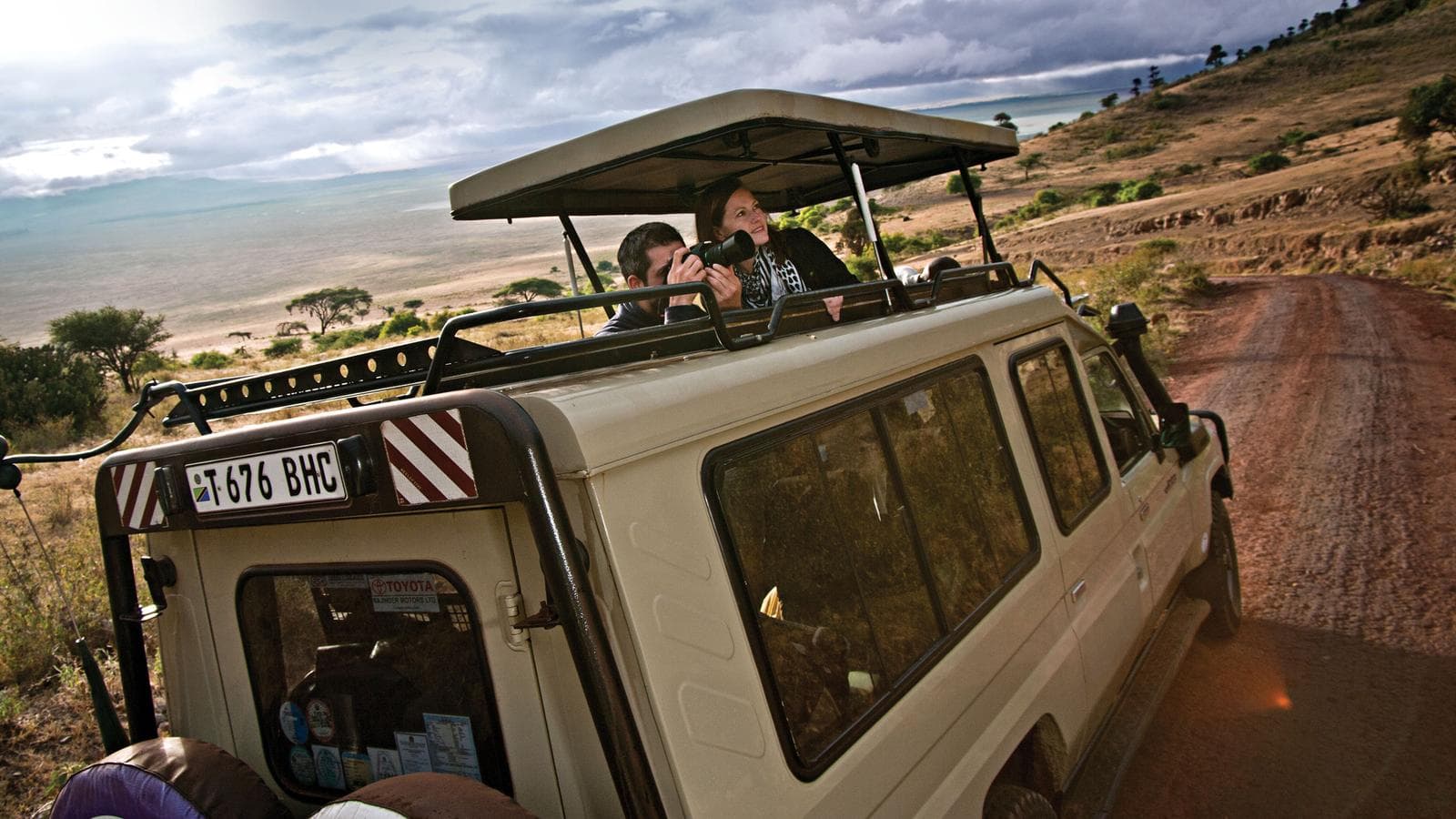
This trip is done in private 7-seat 4x4 safari vehicles. With sliding windows and a large pop-up roofs, these vehicles are designed for wildlife viewing. Road conditions can run the full range of conditions from new to very poor. This style of travel is the best under the local circumstances, as the seats are comfortable and having our own private vehicle allow us the flexibility of making stops when needed, and to stay and watch that crouching lion prepare for an attack.
Speed governors set to 80kph are used on all vehicles to ensure a safe driving speed. Please note for your own safety it is mandatory to wear your seat belt at all times when in a vehicle. All G Adventure vehicles are regularly serviced and follow a strict maintenance schedule. However given the long travel days and rough conditions of many of the roads in Africa, vehicles can and do breakdown on occasion. If such situations occur all drivers are trained mechanics and any vehicle issues are rectified as quickly as possible so as to not disrupt your trip. Your patience is requested if the vehicle you are traveling in happens to encounter a mechanical fault.
Land Transfers & Included Tours/activities: Many of the land transfers and included tours will be by private van, car or taxi, while others may be shared with other travellers depending on availability, nature of the activity and destination. For transfers, you may have a local non English-speaking driver only, for included tours, you will be accompanied by an English speaking local guide.
Mobile tented camp (2 nts), permanent tented camp (1 nt).
Serengeti National Park
Maisha Classic Tented Camp is a mobile tented camp strategically located to cover the game routes and migration corridors of the vast Serengeti Plains. The camp offers unique comfortable accommodation in a traditional time-honoured safari style and provides you with the opportunity to enjoy a real safari camp experience. A cosy mess tent is located in the centre of the camp where the finest in bush cuisine is served by the dedicated safari crew. The evening unwinds around the campfire, during which you get a chance to learn about the fauna and wild life from your CEO and driver guides, discuss the arrangements for the following day with your CEO or simply soak up the nocturnal orchestra that pervades around the bush.
Ngorongoro Crater
Country Lodge is located near the bustling town of Karatu, just outside of the Ngorongoro Conservation Area. Spacious cottage rooms all include a fireplace and are tastefully furnished with netted king or twin beds, tables, writing desk and camp chairs. Relax on comfortable outdoor furniture on the verandah and enjoy the lush garden setting, watch the sun rise or set before heading out on your safari or retire to our main lodge for breakfast or drinks and dinner.
A variety of accommodation standards are available for Independent tours, see your dossier for the accommodation class specific to your tour. Please remember that hotel/lodge/camp standards can be different from what you are used to in your home country, which is part of the appeal of adventure travel. Porterage is not included, but can be arranged directly at most hotels.
Note:
1) Under certain circumstances we reserve the right to change accommodation and provide something slightly different to what is described, though it will always be of similar or better standard/level.
2) Most lodges do not have 24hr electricity - they usually run on generators which are routinely shut off overnight from approximately 10pm to 5am.
3) Internet is not available at the lodges.
4) Lodges are NOT equipped with fans or air conditioning due to the electricity constraints listed above.
For details of your joining hotel please refer to your tour voucher, G Account, the G Adventures App or contact your travel agent.
This tour begins early in the morning of Day 1 in Arusha. Accommodation in Arusha is not included but can be arranged at the time of booking with G Adventures. We recommend that you arrive a day early as your tour departs at 830am on day 1. Similarly, this tour arrives back into Arusha on day 4, in the late afternoon, so you may also choose to pre-book a post-tour accommodation in Arusha.
If you are booking accommodation on your own outside of Central Arusha, please provide us with the hotel name and address at time of booking so we can advise you of the appropriate pick up time and whether any extra transport charges will be incurred.
International flights and some domestic flights into the area actually arrive at the Kilimanjaro International Airport, and if you require, you may be picked up directly from the airport on day 1 for an extra charge.
If arriving into the Arusha Domestic airport on the morning of Day 1, please inform us and we can arrange to commence the tour from there. Whatever your arrangements may be, please be very specific about your requested pick-up point at time of booking the tour.
We don't expect any problems, and nor should you, but if for any reason you are unable to commence your trip as scheduled, as soon as possible please contact your starting point hotel, requesting that you speak to or leave a message for your CEO (if you are not on a group tour please refer to the emergency contact details provided in this dossier). If you are unable to get in touch with your leader, please refer to our emergency contact details. If you have pre-booked an airport transfer and have not made contact with our representative within 30 minutes of clearing customs and immigration, we recommend that you make your own way to the Starting Point hotel, following the Joining Instructions. Please apply to your travel agent on your return for a refund of the transfer cost if this occurs.
Should you need to contact us during a situation of dire need, it is best to first call either the G Adventures Local Representative (if one is listed below) or our G Adventures Local Office. If for any reason you do not receive an immediate answer, please leave a detailed message and contact information, so they may return your call and assist you as soon as possible.
AIRPORT TRANSFER
If you have purchased an arrival through G Adventures or if an arrival transfer is included in the cost of your tour, please note that:
Your arrival transfer has been arranged based on flight information provided to us. If you are advised of a flight schedule change within 48 hours of your scheduled arrival time, we will do our best to rearrange your arrival transfer however we cannot guarantee this. If your arrival transfer does not arrive within 30 minutes after you have exited the arrivals area please take a taxi to your start point hotel.
EMERGENCY CONTACT NUMBERS
G Adventures Local Representative (Tanzania)
Mussaddiq
During office hours, Mon-Fri, 9am-5pm local time
From outside Tanzania: +255 27 250 7322 or +255 27 250 3929
From within Tanzania: 027 250 7322 or 027 250 3929
After office hours emergency number
From outside Tanzania: +255 754 400 141 or +255 784 400 141
From within Tanzania: 0754 400 141 or 0784 400 141
G Adventures Local Office (Nairobi, Kenya)
Emergency number:
From outside Kenya: +254 727 208 832
From within Kenya: 0727 208 832
If you are unable for any reason to contact our local office, please call the numbers listed below which will connect you directly with our Sales team who will happily assist you. Hours of operation by region can be found here.
Toll-free, North America only: 1 888 800 4100
Calls from UK: 0344 272 0000
Calls from Germany: 0800 365 1000
Calls from Australia: 1 300 796 618
Calls from New Zealand: 0800 333 307
Outside North America, Australia, New Zealand, Germany and the UK: +1 416 260 0999
This tour ends upon arrival into Arusha in the afternoon of day 4. Though this tour does not include accommodation in Arusha, you may choose to pre-reserve a room at our finishing point hotel for after your tour through G Adventures.
You will be on the move a lot, so our advice is to pack as lightly as possible. Your baggage should be clearly labelled and restricted to one soft compact suitcase, sports bag, or backpack, no larger than 30cm(height) x 30cm(width) x 60cm(length), maximum 15kg, plus a daypack. Luggage limits on airlines are strictly enforced, and due to limited vehicle capacity, the cost of transporting any luggage beyond these restrictions is the responsibility of the client. Please note, if you are travelling with a large amount of luggage and wish to leave a portion of it at the start hotel, this is indeed possible as storage facilities are available.
It is important to pack clothes for warm days and cool evenings, as well as a warm jacket for early morning wildlife safari drives. Light, quick-drying, practical clothes are advisable for this safari trip. A set of smart casual clothes is also advisable for your time in Arusha.
Cold Weather:
• Long-sleeved shirts or sweater
• Scarf
• Warm gloves
• Warm hat
• Warm layers
• Warm waterproof jacket
Documents:
• Flight info (required) (Printouts of e-tickets may be required at the border)
• Insurance info (required) (With photocopies)
• Passport (required) (With photocopies)
• Vouchers and pre-departure information (required)
• Visas or vaccination certificates (With photocopies)
Essentials:
• Toiletries (required) (Shampoo, bodywash, soap, etc.)
• Binoculars (optional)
• Camera (With extra memory cards and batteries)
• Cash, credit and debit cards
• Day pack (Used for daily excursions or short overnights)
• Ear plugs
• First-aid kit (should contain lip balm with sunscreen, sunscreen, whistle, Aspirin, Ibuprofen, bandaids/plasters, tape, anti-histamines, antibacterial gel/wipes, antiseptic cream, Imodium or similar tablets for mild cases of diarrhea, rehydration powder, water purification tablets or drops, insect repellent, sewing kit, extra prescription drugs you may be taking)
• Flashlight/torch (Headlamps are ideal)
• Fleece top/sweater
• Footwear
• Hat
• Headphones (Noise-cancelling recommended)
• Locks for bags
• Long pants/jeans
• Moneybelt
• Outlet adapter
• Personal entertainment (Reading and writing materials, cards, music player, etc.)
• Reusable water bottle
• Shirts/t-shirts
• Sleepwear
• Small travel towel
• Sunglasses
• Swimwear
• Watch and alarm clock
• Waterproof backpack cover
• Windproof rain jacket
Warm Weather:
• Sandals/flip-flops
• Shorts/skirts (Longer shorts/skirts are recommended)
• Sturdy water shoes/sandals
• Sun hat/bandana
• Swimwear
Note: The climate in East Africa varies between the dry and rainy season. Please ensure you bring a windproof rain jacket if you are travelling between April & May, October & November.
Laundry facilities are offered by some of our hotels and lodges for a charge. You should write a list of items that you send for washing. It will be difficult for hotels to have your laundry ready if you arrive in the late afternoon and leave the next morning, so the lodge in the Serengeti would be best, since you are there for 2 nights.
All countries require a valid passport (with a minimum 6 months validity). Contact your local embassy or consulate for the most up-to-date visa requirements, or see your travel agent. It is your own responsibility to have the correct travel documentation. Visa requirements for your trip will vary depending on where you are from and where you are going. We keep the following information up to date as far as possible, but rules do change and sometimes without warning. While we provide the following information in good faith, it is vital that you check the information yourself and understand that you are fully responsible for your own visa requirements.
Visa information specific to your destination and nationality can be found in our Important Pre-Departure Information page here
Please note that upon arrival by air to Arusha, Tanzania, most nationals can obtain a visa for US$50 in $US cash (valid for those who would be permitted a Tanzania visa while still in their own country), though the visa currently costs $100 for U.S. nationals. This visa is valid for up to 3 months with multiple entries/exits permitted to Kenya and Uganda only. If you are transiting through Uganda or Kenya, you will have to purchase a transit visa en route. These are usually $US20 or US$10 respectively, and valid for 24 hours. Alternatively, for either of these two countries, you may purchase a normal visa for US$30 and US$25 respectively (most nationals), both of which are valid for up to 3 months. As fees and policies can change, we highly recommend that you contact your local embassy or consulate for the most up-to-date visa requirements, or see your travel agent. It is your responsibility to have the correct travel documentation.
East Africa Tourist Visa
An East Africa Tourist Visa allows the holder to move freely between Kenya, Rwanda and Uganda with only one Visa, and is valid for a period of 90 days. It also acts as a multiple entry Visa, so if you leave any of the above countries, you do not need a new Visa to re-enter (provided it is within the 90 day validity period). These need to be applied for in advance, and you should contact the foreign Embassy (of the country you will be entering through) for more details. The cost is 100USD.
Please see below for more information:
http://www.visiteastafrica.org/visa/
IMPORTANT NOTE
It may be required to show a Yellow Fever certificate upon entering the country. Please check in with your local consulate and health expert for advice on Yellow Fever and other inoculations required for this area.
American Dollars that are series 1999 or earlier are not accepted and very difficult to change in Southern and Eastern Africa, because of past forgeries.
REGIONAL INFORMATION
Climate
There are generally two rainy seasons - the short and the long rains. The short rains normally occur from late October through November, and the long rains from late March through to early June. A good time to visit is between late June and October when the rains have finished and the air is coolest. Alternatively, from late December to early March is another good time to visit, just after the short rains, but before the long rains; this is the warmest time of the year. The highest season for travellers into the region is in January and February, when the hot, dry weather is generally considered to be the most pleasant.
Electricity
The electric current in Tanzania operates on 230V, 50Hz.
Language
The official languages are Swahili and English. There are also numerous dialects spoken throughout.
TANZANIA - Offical Statistics
Full country name: United Republic of Tanzania (Jamhuri ya Muungano wa Tanzania)
Area: 945,087 km2
Population: 38,329,000-July 2005 est (34,443,603-2002 census)
Capital city: Dodoma
People: 99% native African (over 100 tribes), 1% Asian, European and Arabic
Languages Swahili, English, indigenous.
Religion: 40% Christian, 33% Muslim, 20% indigenous beliefs
Government: Republic (multi-party state)
President: Benjamin William Mkapa
Major industries: Tobacco, sugar, sisal, diamond and gold mining, oil refining, cement, tourism
Major trading partners: India, Germany, Japan, Malaysia, Rwanda, the Netherlands, South Africa, Kenya, U.K., Saudi Arabia, China Currency: Tanzanian shilling
INTERESTING FACTS
• The name is name made up from an amalgamation of TANganyika and ZANzibar.
• Tanzania is the largest country in East Africa (although not in Africa as a whole, the Sudan is 3 times larger); it’s landmass covering an area of just over 945,087 sq. km (including Zanzibar).
• This makes Tanzania about the size of France, Germany and Switzerland combined; 3 times the size of the entire British Isles or one-tenth the size of the whole of the USA.
• Tanzania’s population at the last official census was 31.3 million, with approximately one third being classified as “urban”.
• Agriculture forms roughly half of GDP and agriproducts (e.g.: coffee, tea, tobacco, cashew nut, sisal, cotton) some 75% of export earnings. Dodoma, in central Tanzania, is the political capital of the country although Dar es Salaam is the effective trading and business capital, with its safe harbour ("Dar es Salaam” means “Haven of Peace”), international airport and population of some 1.75million.
Every traveller is different and therefore spending money requirements will vary. Some travellers may drink more than others while other travellers like to purchase more souvenirs than most. Please consider your own spending habits when it comes to allowing for drinks, shopping and tipping. Please also remember the following specific recommendations when planning your trip.
The local currency in Tanzania is the Tanzanian Shilling (TSH).
Shillings can be obtained locally by changing foreign currency or by using ATMs (where available) which will disperse local currency. Your CEO will inform you where you can change money throughout the tour and approximately how much money you will need for each country.
The easiest foreign currency to exchange for locally for any of the local currencies is the $US; however the British Pound and Euro may also be exchanged as well. Please note that due to past problems with forgery, $US notes that are older than year 2006 are not accepted in Africa.
Large note ($US 50, $US 100 etc) can be difficult to change in some places, but will gain you the best exchange rate.
If you plan to rely on cash, please bring foreign currency (Euro, Pound, USD) with you, as it is often expensive to buy these currencies locally. And in more rural areas, it is often not likely.
If you plan to buy your visas at borders, you will need to bring $USD cash to pay for these visas. Please note you cannot use the local currency or any other currency to buy these visas- they must be purchased in USD.
Please do not bring Travellers’ cheques toAfrica. They are difficult if not impossible to exchange in many places.
Visa/Plus system cards are the most widely accepted debit cards. it is harder to find machines Mastercard/Cirrus cards. We highly recommend that if you hold a Mastercard, you obtain a Visa card prior to departure and travel with both. This is also useful should somethingunforeseen happen to one of your cards during your travels.
While there are many ATMs in the major centres, there are no guarantees that your credit or debit cards will actually work in Africa. Check with your bank.
Credit cards can be used in major cities and towns ONLY but please do not rely on them as a method of payment because they are generally not widely accepted. You should be aware that to purchase products or services on a credit card a fee of 5%-10% usually applies. The majority of our optional activities can also be paid by credit card. Your CEO will advise on these.
Please note that in many areas there may be occasional power-outages, where there will be no electricity for hours at a time. In addition, ATMs outside of larger centers often run out of cash or can be out of order unexpectedly. These factors could affect your ability to access money from ATMs. As such, please do not rely on credit or debit cards as your only source of money.
A combination of foreign currency and debit/credit cards for cash advances is best. Always take more rather than less, as you don't want to spoil the trip by constantly feeling short of funds.
As currency exchange rates can fluctuate often we ask that you refer to the following website for daily exchange rates: www.xe.com.
Please also make sure you have access to at least an additional USD $200 (or equivalent) as an 'emergency' fund, to be used when circumstances outside our control (ex. a natural disaster) require a change to our planned route. This is a rare occurrence!
USD30, usually included in most international air tickets.
Tipping during your tour is optional, but the gesture is expected as a way to show your satisfaction with the persons who have assisted you on your tour.
Although it may not be customary for you, it is of considerable significance to the people who will take care of you during your travels, as an important source of income for those in the tourism industry. It is one of the most direct ways that you can have a positive economic impact within the communities that you visit.
Giving a tip should be seen as a formal 'thank you', and the action should in no way be awkward. The best method of tipping someone that has served the whole group is to plan in advance, and not rush when it comes to saying goodbye. A suggestion would be for each group member to contribute anonymously by putting their tip into an envelope. This often works the best and the group as a whole should gather to present the gift to the recipient(s), offering their thanks and showing their appreciation. This method brings the action out into the open, allowing for a friendly and appreciative interaction between the group and the recipient(s).
You may use the following as a guideline, all given in a per client format:
G CEOs and drivers: $3-4 USD each, per day worked.
While on safari:
Certified Safari Guide/Driver: $5-10 USD (full day)
Supply Driver $3-5 USD (full day).
Restaurant/Café servers: 10% of cost of bill, especially when in a large group (no envelope required).
Local guides: $1 USD for every couple of hours
Serengeti National Park
- Serengeti Balloon Safari
Please note inoculations may be required for the country visited. It is your responsibility to consult with your travel doctor for up to date medical travel information well before departure.
We recommend you contact your family physician, or your local travel clinic for the most up-to-date health information at least one month before departure.
Please ensure you have all the inoculations recommended by your doctor for travel in East Africa. Be aware that Tanzania have many regions where malaria is present. We thus recommend that you take malaria medication; your doctor should be able to recommend the necessary prophylactics. Travellers should also carry a basic travel first-aid kit as medical facilities are basic in Tanzania. An important item to include is a liquid or gel hand sanitizer and/or alcoholic/sanitary wipes, as they will aid in personal cleanliness and hygiene throughout the trip. The local tap water should not be consumed, so any water treatment tablets (ex. iodine), drops, etc, would help, but good, clean, and inexpensive bottled water is widely available throughout the entire trip. If you have any pre-existing medical condition, you must inform G Adventures prior to the purchase of the tour, and upon arrival, to the CEO so he/she can be prepared to help you.
Yellow Fever Certificate:
It may be required to show a Yellow Fever certificate upon entering the country visited. Please check in with your local health expert for advice on Yellow Fever and other inoculations required for this area.
Sand flies and Mosquitos:
Are found in the areas visited. Mosquitos are more prevalent in areas that receive more rainfall, and sand flies, though generally found on the coast, can also be found in dry & dusty conditions inland. Both tend to come out in the early evening and early mornings. Protective clothing, and insect repellent are highly recommended during these times.
Malaria:
This infectious disease is transmitted by mosquitos carrying the parasite. These mosquitos are found at altitudes of under 1,800m, and thus can be found in most areas that we visit on this tour. You must have prophylactics which you can obtain from your local doctor at or health clinic.
Sun:
It is very important that you wear sun block, even on a cloudy day when it feels cool as we are near the equator and the sun is very strong. A sunburn can turn a pleasant trip into a painful trip.
Hydration
Even when days are cool please be sure to drink a minimum of two litres of water and refrain from drinking to many diuretics, as while when travelling outdoors the breeze can dehydrate you quickly as well as the heat.
Diarrhoea:
It is normal for people travelling overseas to get an upset stomach due to a change of climate and food. Please make sure that you wash your hands and stay away from street food.
Many national governments provide a regularly updated advice service on safety issues involved with international travel. We recommend that you check your government's advice for their latest travel information before departure. We strongly recommend the use of a neck wallet or money belt while travelling, for the safe keeping of your passport, air tickets, travellers' cheques, cash and other valuable items. Leave your valuable jewellery at home - you won't need it while travelling. Many of the hotels we use have safety deposit boxes, which is the most secure way of storing your valuables. A lock is recommended for securing your luggage. When travelling on a group trip, please note that your CEO has the authority to amend or cancel any part of the trip itinerary if it is deemed necessary due to safety concerns. Your CEO will accompany you on all included activities. During your trip you will have some free time to pursue your own interests, relax and take it easy or explore at your leisure. While your CEO will assist you with options available in a given location please note that any optional activities you undertake are not part of your itinerary, and we offer no representations about the safety of the activity or the standard of the operators running them. Please use your own good judgment when selecting an activity in your free time. Although the cities visited on tour are generally safe during the day, there can be risks to wandering throughout any major city at night. It is our recommendation to stay in small groups and to take taxis to and from restaurants, or during night time excursions.
Protests and Demonstrations- Protests and demonstrations, even those that are well intended, have the potential to turn violent with no warning. Counter protests can also turn violent. Action by security forces to disperse demonstrators and protesters may occur at any time. If you are in an area where demonstrators or protesters are gathering, avoid the temptation of staying for a good photo opportunity and leave the area immediately.
Water based activities have an element of danger and excitement built into them. We recommend only participating in water based activities when accompanied by a guide(s). We make every reasonable effort to ensure the fun and adventurous element of any water based activities (in countries with varying degrees of operating standards) have a balanced approach to safety. It is our policy not to allow our CEOs to make arrangements on your behalf for water based activities that are not accompanied by guide(s).
Swimming, including snorkeling, is always at your own risk.
We take all prudent measures in relation to your safety. For ways to further enhance your personal safety while traveling, please visit:
www.gadventures.com/travel-resources/safety/
Arusha
-People are generally friendly in Arusha, but don’t let people take advantage of you
-Always leave your passport (It’s better to carry a photocopy of it instead), traveller’s cheques, flight tickets and money that you won’t be using in the safe deposit in your hotel room/reception. This is free of charge to G Adventures clients.
-Remember that like in any other city, you should never leave your bags unattended, nor flaunt jewellery, cameras etc
-Please don’t wander through the city at night. Stick to the main streets only during the day, and after sundown, please take a taxi. Taxis can be organised from reception of your hotel. Also, take the address of the hotel with you.
-Beware of people approaching you on the street with an apparent interest of where you are from, and want to sit down and have a chat with you. These people are con men and will ask you for money.
-People on the street who ask you if you want a safari and have a brochure are often con men, best to avoid these folk. Besides, you’re already on safari!
Photography
Please refrain from taking photos of police stations, airports, bus stations, immigration are border crossings, army barracks and personnel, or any government building. It is against the law and will result in the minimum of your film and camera being confiscated.
Illegal drugs will not be tolerated on any trips. Possessing or using drugs not only contravenes the laws of the land but also puts the rest of the group at risk. Smoking marijuana and opium is a part of local culture in some parts of the world but is not acceptable for our travellers. Our philosophy of travel is one of respect towards everyone we encounter, and in particular the local people who make the world the special place it is. The exploitation of prostitutes is completely contrary to this philosophy. Our CEOs have the right to expel any member of the group if drugs are found in their possession or if they use prostitutes.
Travel Insurance: Travel insurance is compulsory in order to participate on any of our trips. When travelling on a group trip, you will not be permitted to join the group until evidence of travel insurance has been sighted by your CEO, who will take note of your insurance details. When selecting a travel insurance policy please bear in mind that all clients must have medical coverage and that we require a minimum coverage of USD 200,000 for repatriation and emergency rescue. We strongly recommend that the policy also covers personal liability, cancellation, curtailment and loss of luggage and personal effects. If you have credit card insurance we require proof of purchase of the trip (a receipt of credit card statement) with a credit card in your name. Contact your bank for details of their participating insurer, the level of coverage and emergency contact telephone number.
Planeterra International Foundation is a non-profit organization committed to turning travel into impact by helping local communities earn an income from tourism. Planeterra connects underserved local communities to the benefits of tourism by developing and supporting small community-owned businesses. These businesses support Indigenous people, empower women, grant youth access to employment opportunities, and protect the environment. Planeterra also works to ensure these businesses have a thriving customer base by integrating their projects into G Adventures’ itineraries globally.
G Adventures is Planeterra’s largest corporate donor, covering all operating costs, so 100% of your donation will bring opportunity to people in need.
G Adventures Dollar-a-day Program - Make Every Day Count - Turn your travel into impact with Planeterra Foundation.
Did you know? Most communities around the world do not benefit from tourism. Give back to the places you visit on your travels by creating opportunities for local people to earn an income, and protect the environment.
Make every day count by donating $1/day for the length of your trip, and join us in empowering the communities you will visit when you travel. 100% of your donation goes directly to Planeterra projects.
Earn 5% off your next G Adventures Tour (up to $100 USD)*
After your travels, we want to hear from you! Your feedback information is so important to us and to thank you for your time, we are pleased to offer a 5% discount (up to a maximum of $100 USD) off your next G Adventures holiday. All you need to do is submit the form within 4 weeks of the completion of your tour, and you'll be able to join the thousands of travellers who have taken 2, 3, 4 or even 10 or more tours with us!
Discount cannot be combined with other offers or applied to 'Independent' style trips. Maximum discount value is $100 USD (or equivalent currency). Valid for new bookings only. G Adventures reserves the right to withdraw or modify this offer at any time without notice. Limited to one discount per person.
Our adventure travel e-newsletter is full of travel news, trip information, interesting stories and contests. To avoid missing out on special offers and updates from G Adventures, subscribe at www.gadventures.com/newsletters/
Stay current on how our company invests in our global community through our foundation – Planeterra. Sign up for Planeterra's monthly news to learn more about how to give back and support the people and places we love to visit.
Minimum age of 2 years for this trip.
No, international flights are generally not included in the price of your tour.
However, on some combo tours travelling between two different countries, international flights are included as part of the itinerary and price of the tour. Please speak to your GCO or booking agent for further details.
In addition, check-in times and baggage allowances/restrictions vary by airline and can change at any time. For the most up-to-date information for your flight, please contact your airline. We recommend checking in online in advance to avoid potential delays at the airport.
CEO (Chief Experience Officer) who is a certified safari guide/driver.
The safety and well-being of all of our travelers is a priority at G Adventures and that includes our travelers who identify as part of the LGBTQ+ community. We recognize that there are specific concerns and questions you may have about your adventure in terms of safety and security. We encourage you to visit our LGBTQ+ page for useful resources to ensure you feel safe and comfortable throughout the duration of your trip. The Equaldex tool linked on this page can be of particular help when deciding where you may want to visit next.