Tanzania: Kilimanjaro's Machame Route & Serengeti Wildlife
14 days, From Moshi to Arusha, From $5,749 USD
Tour Overview
Your adventure snapshot
Trip CodeDTUS
Days14
FromMoshi
ToArusha
Countries VisitedTanzania
Countries VisitedTanzania
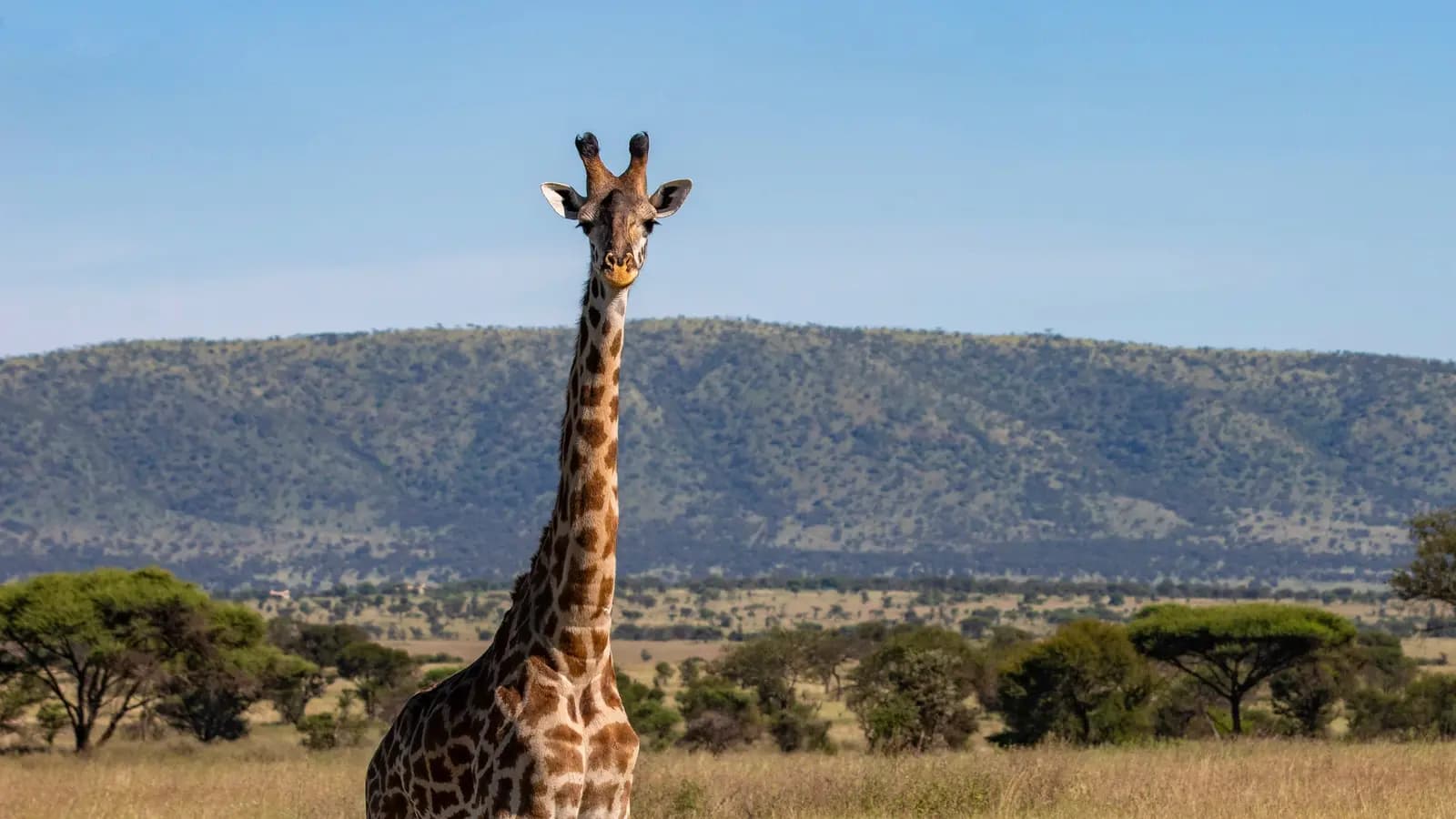
Fourteen days. Africa's highest peak and its greatest wildlife stage — back to back. Kilimanjaro's Machame Route threads through forest and glaciers before Uhuru Peak delivers the summit sunrise. Then the Serengeti opens up in all its stampeding glory, Ngorongoro Crater descends, and Tarangire's elephant herds round out a trip that packs more into a fortnight than most manage in a lifetime.Is this tour for me?
Travel Style
Classic
All of the highlights, culture, access, and I-can’t-believe-we-did-that moments, all at a great price.Service Level
Standard
Physical Grading
5 - Challenging
Trip Type
Small Group
Age Requirement
12+
Under age 18 must be with an adultTrees for Days
Ripple Score
Tour Highlights
The moments you’ll brag about later
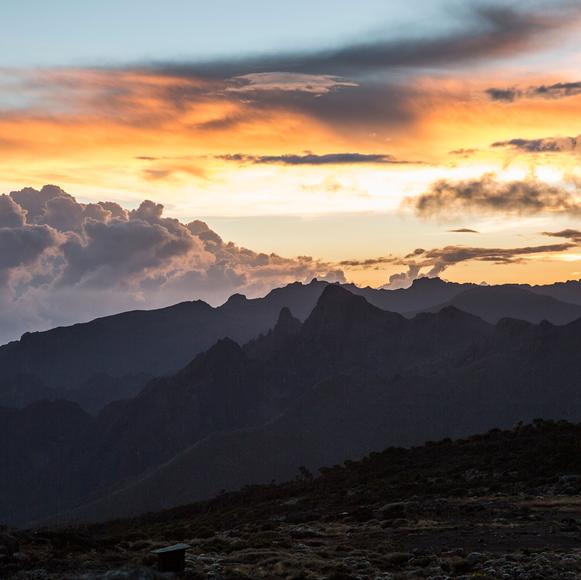
Included on Day 4
Shira 2 Camp to Lava Tower
The route becomes increasingly challenging and steep. Some hikers might start to feel weak or short of breath from the altitude so go slowly— “pole pole” as they say in Swahili—to avoid exasperating the symptoms.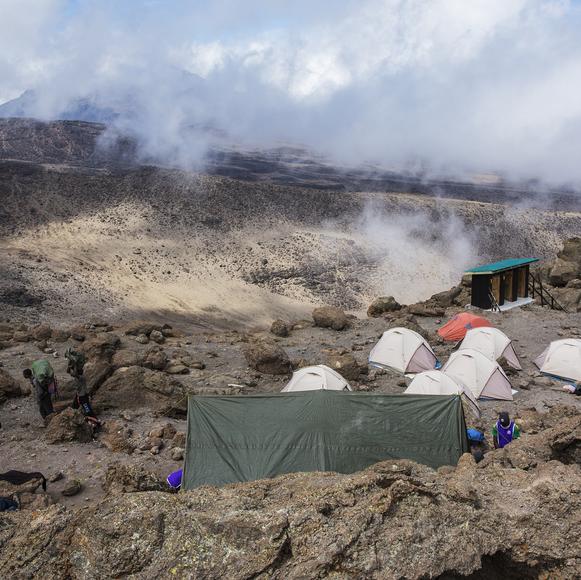
Included on Day 6
Barafu Camp to Stella Point
Enjoy a snack and warm drink and get ready for the ascent in the dark up the northwest scree. Go slowly as the terrain is rocky and difficult, pass between the Rebmann and Ratzel glaciers before arriving at Stella Point.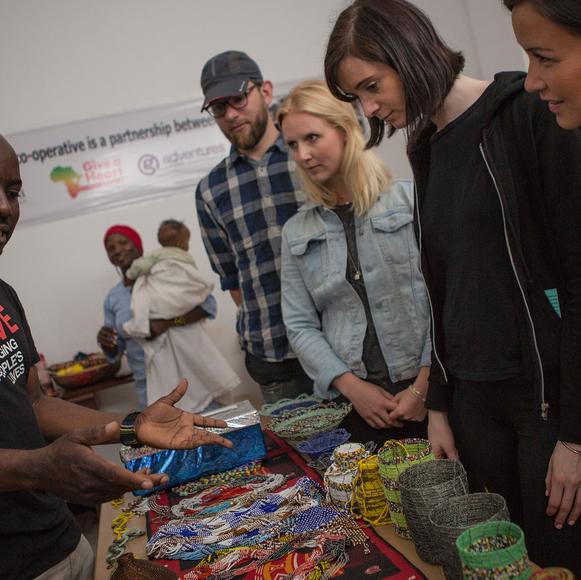
Included on Days 7 & 8
Moshi Women's Cooperative Visit
This project is supported by the Planeterra Foundation and G Adventures. Women and girls are often the first to be excluded from educational programs in Tanzania, with most girls being pulled out of school by Grade 3 to help out around the home.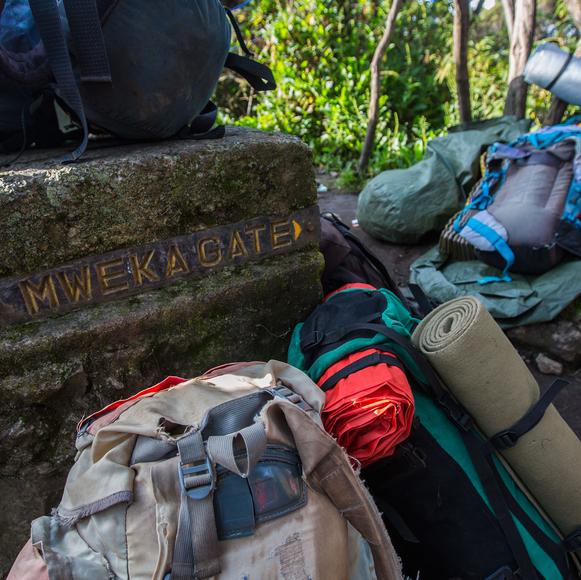
Included on Day 7
Mweka Camp to Mweka Gate
Hike downhill to the Mweka Gate. Enjoy the lower altitude and the view of the forested slopes of Mt Kilimanjaro. Upon arrival to Moshi in the afternoon, relax, or opt to have that much-deserved shower and congratulatory beverage.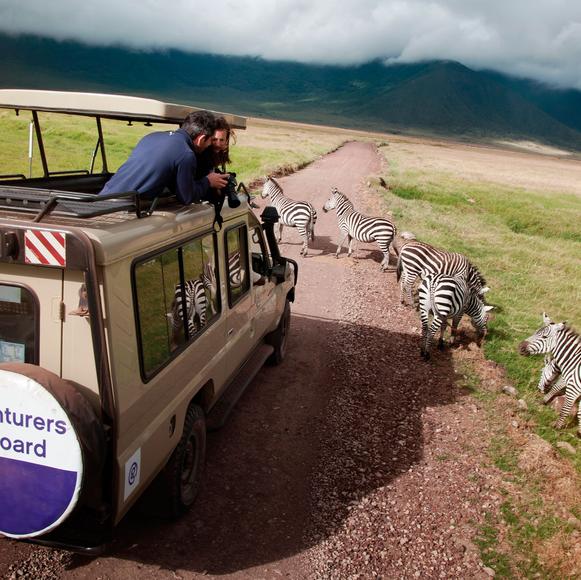
Included on Day 12
Ngorongoro Crater Wildlife Safari Drive
Set the alarm and prepare for an early start to see the wonders of the Ngorongoro Crater. Keep your eyes peeled and camera ready to capture a pride of lions or a lone leopard walking along the savanna.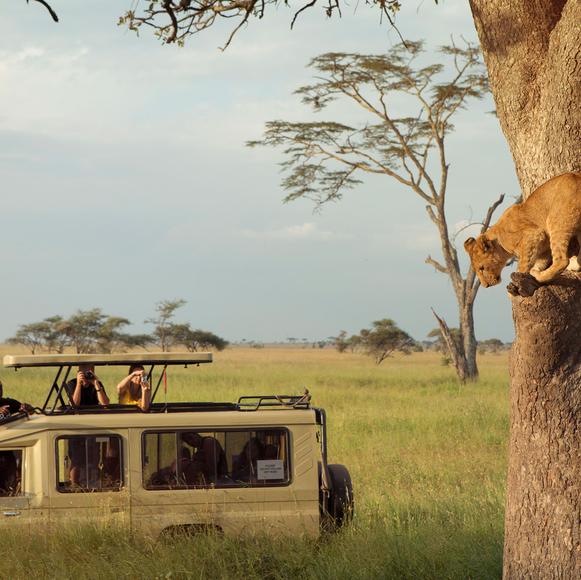
Included on Day 12
Serengeti National Park Wildlife Safari Drive
Charge your camera, grab your binoculars and set out on safari. Your eagle-eyed driver will keep an eye out for wildlife – buffaloes, elephants, lions, wildebeests, zebras and more.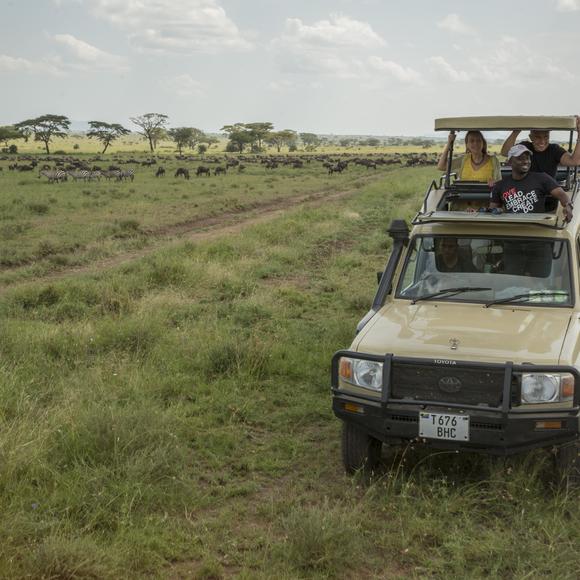
Included on Day 13
Full-Day Serengeti National Park Wildlife Safari Drive
Spend the entire day in the gorgeous landscapes of Serengeti National Park, a true icon of Eastern Africa.
Available on Day 13 for an additional cost
Serengeti Balloon Safari
Spirited aloft in a hot-air balloon, view the wildlife and terrain of the Serengeti that only the birds see. Enjoy a champagne breakfast and keep that shutter-finger good and limber.What’s included
- AccommodationHotels (6 nts), Full-service alpine camping (5 nts), Comfortable Tented Camp with en suite facilities (2 nts).
- Meals Included13 breakfasts, 10 lunches, 9 dinners
- TransportPrivate minibus, trekking, 4x4 safari vehicles, private vehicles.
The Extras
- Your flightCall us, we can help.
- Lake Manyara National Park Afternoon Safari DriveFrom $99 USD - Optional activity (pre-bookable).
- Lalasalama Spa & Beauty Aromatherapy MassageFrom $55 USD - Optional activity (pre-bookable).
14 days, Moshi to Arusha
The story of your trip, one day at a time
Week 1/2
Week 1/2
Dates & Availability
The countdown starts here
Start DateJan 9
End DateJan 22
✕Sold out
Frequently asked questions
All the A's to your Q's
Your G for Good Moment: Moshi Women's Cooperative Visit, Moshi
Your G for Good Moment: Mto wa Mbu Community Visit and Lunch, Mto wa Mbu
Your Welcome Moment: Meet Your CEO and Group. 6-day guided group trek up Mt Kilimanjaro's Machame Route with local guides, cooks and porters. All permits and fees. Two safari drives in Tarangire National Park. Coffee harvesting tour in Karatu. Scenic safari drive in Ngorongoro Crater. Sunset safari drive in Serengeti. Full-day safari drive in Karatu and Serengeti National Park. Free time in Serengeti National Park. All transport between destinations and to/from included activities.
Your G for Good Moment: Mto wa Mbu Community Visit and Lunch, Mto wa Mbu
Your Welcome Moment: Meet Your CEO and Group. 6-day guided group trek up Mt Kilimanjaro's Machame Route with local guides, cooks and porters. All permits and fees. Two safari drives in Tarangire National Park. Coffee harvesting tour in Karatu. Scenic safari drive in Ngorongoro Crater. Sunset safari drive in Serengeti. Full-day safari drive in Karatu and Serengeti National Park. Free time in Serengeti National Park. All transport between destinations and to/from included activities.
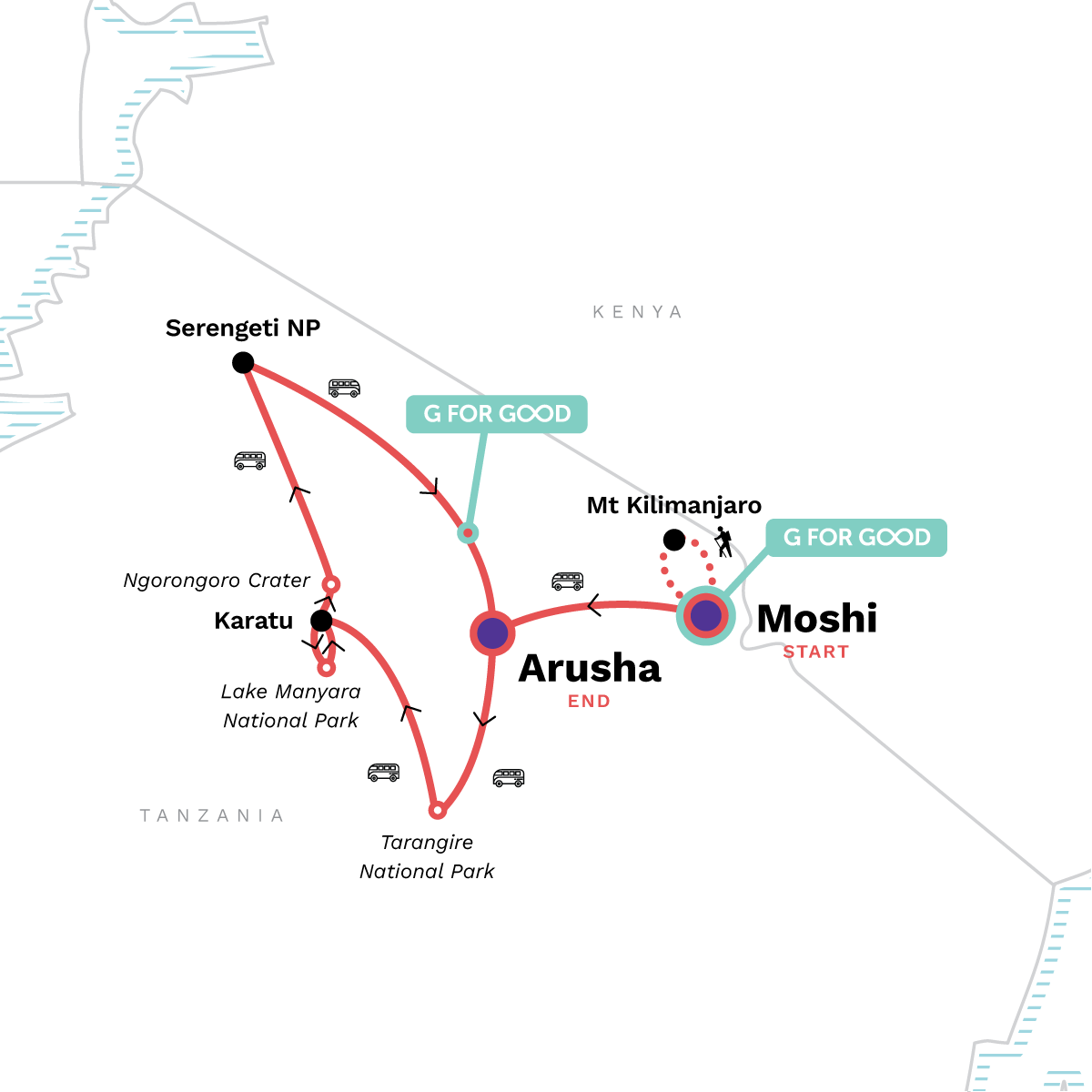
Tackle the Machame Route — Kilimanjaro's most scenic and celebrated path, Trek through forest and moorland before glaciers and high-alpine deserts take over, Stand at Uhuru Peak at sunrise and witness the curvature of the earth, Roam the iconic Serengeti in search of wildebeest and prowling lions, Descend into Ngorongoro Crater — one of the largest intact calderas on earth, Spot towering termite mounds and elephant herds in Tarangire National Park
The information in this trip details document has been compiled with care and is provided in good faith. However it is subject to change, and does not form part of the contract between the client and the operator. The itinerary featured is correct at time of printing. It may differ slightly to the one in the brochure. Occasionally our itineraries change as we make improvements that stem from past travellers, comments and our own research. Sometimes it can be a small change like adding an extra meal along the itinerary. Sometimes the change may result in us altering the tour for the coming year. Ultimately, our goal is to provide you with the most rewarding experience. Please note that our brochure is usually released in November each year. If you have booked from the previous brochure you may find there have been some changes to the itinerary.
VERY IMPORTANT: Please ensure that you view a final copy of your Trip Details a couple of days prior to travel, in case there have been changes that affect your plans.
VERY IMPORTANT: Please ensure that you view a final copy of your Trip Details a couple of days prior to travel, in case there have been changes that affect your plans.
While it is our intention to adhere to the route described below, there is a certain amount of flexibility built into the itinerary and on occasion it may be necessary, or desirable to make alterations. The itinerary is brief, as we never know exactly where our journey will take us. Due to our style of travel and the regions we visit, travel can be unpredictable. The Trip Details document is a general guide to the tour and region and any mention of specific destinations or wildlife is by no means a guarantee that they will be visited or encountered. Aboard expedition trips visits to research stations depend on final permission.
Additionally, any travel times listed are approximations only and subject to vary due to local circumstances.
Additionally, any travel times listed are approximations only and subject to vary due to local circumstances.
Once the park fees are paid Kilimanjaro International Park is not able to provide refunds for any unused days.
Please note: passengers should be aware that, for any reason, they are unable to make the trek to the summit, then any additional cost will be at their own expense.
INSURANCE
While hiking Kilimanjaro to Uhuru Peak, you will be climbing to nearly 6,000 metres above sea level. Many insurance policies do NOT cover helicopter rescues at this elevation, so please check your benefits to ensure it includes emergency rescue services above 6,000m.
YELLOW FEVER: COUNTRY DETAIL
There is no risk of Yellow Fever transmission in Botswana, Kenya, Malawi, Namibia, South Africa, Tanzania, Uganda, Zambia, or Zimbabwe. However, all of these countries require proof of vaccination under International Health Regulations to prevent importation of the virus. It is compulsory to show a valid Yellow Fever vaccination certificate if you are travelling to any of the above countries from a Yellow Fever endemic country, or have recently transited through one (12 hours or more in airport). Endemic countries include: Angola, Benin, Bolivia, Brazil, Burkina Faso, Burundi, Cameroon, Central African Republic, Chad, Colombia, Democratic Republic of the Congo, Republic of the Congo, Côte d'Ivoire, Ecuador, Equatorial Guinea, Ethiopia, French Guiana, Gabon, Gambia, Ghana, Guinea, Guinea-Bissau, Guyana, Kenya, Liberia, Mali, Mauritania, Niger, Nigeria, Panama, Paraguay, Peru, Rwanda, São Tomé and Príncipe, Senegal, Sierra Leone, Somalia, South Sudan, Sudan, Suriname, Tanzania, Togo, Trinidad and Tobago, Uganda, Venezuela. We advise all travellers on Southern and East Africa itineraries to carry a valid Yellow Fever vaccination certificate regardless of their country of origin. Given the multi-country nature of these itineraries, travellers will cross borders into countries that require the certificate as a condition of entry from preceding destinations. A traveller entering the itinerary from a non-endemic country may not require the certificate to enter the first country, but will almost certainly require it by the time they cross into a subsequent one. Yellow Fever vaccinations must be administered at least 10 days prior to entry into the first country visited. Under WHO regulations (effective 11 July 2016), certificates are valid for the lifetime of the person vaccinated, there is no 10-year expiry on the certificate itself, though some border officials may be unaware of this. Travellers should carry their original International Certificate of Vaccination or Prophylaxis (yellow card) at all times during the tour. Travellers without a valid certificate run the risk of being denied entry and will not be able to continue with the tour. Any additional travel expenses incurred will be at the traveller's own account.
LUGGAGE COMPLICATIONS FLYING INTO KILIMANJARO: It occasionally happens that luggage on international flights into Kilimanjaro does not arrive. Please be aware that this may happen, especially if you have a tight connection, are flying with different airlines with a connection, have a last minute flight change or re-route, or fly from or connect through another African centre. Please be prepared and keep all important documentation and valuables on your person. As well we recommend a change of clothes in your hand luggage. If unfortunately this does happen, and your luggage does not arrive, you should be entitled to a limited initial compensation from your airline. In Kilimanjaro, the arrival of lost luggage normally takes between 48 and 72 hours after the initial plane’s arrival. The airlines technically should be responsible to forward your luggage to you, to your hotel or elsewhere in Tanzania. You may find that you will be needed to start your trek and you still have not received your luggage. Considering that the customer service standards in Tanzania are different from home, and that we find that the airlines are not always pro-active in helping luggage in its care be reunited with its owner, it is recommended that you purchase or hire locally the needed items, and speak to your G Adventures representative at your hotel to persist with your airline to retrieve your luggage. Once your luggage is retrieved, it should be able to be forwarded to you – depending where you are. Please note that any costs that you may incur for luggage retrieval or sending luggage are not the responsibility of G Adventures, though we will always strive to assist you in any way possible. You should always keep all receipts and documentation, and contact your airline or insurance provider for reimbursement.
COMBO TRIP
Please note that this tour combines with other G Adventures tours. As such, the staff and some travel companions on your tour may have previously been traveling together with G Adventures, prior to Day 1 of your tour. Likewise, some staff and travel companions may be continuing together on another G Adventures tour, after your trip concludes.
Please note: passengers should be aware that, for any reason, they are unable to make the trek to the summit, then any additional cost will be at their own expense.
INSURANCE
While hiking Kilimanjaro to Uhuru Peak, you will be climbing to nearly 6,000 metres above sea level. Many insurance policies do NOT cover helicopter rescues at this elevation, so please check your benefits to ensure it includes emergency rescue services above 6,000m.
YELLOW FEVER: COUNTRY DETAIL
There is no risk of Yellow Fever transmission in Botswana, Kenya, Malawi, Namibia, South Africa, Tanzania, Uganda, Zambia, or Zimbabwe. However, all of these countries require proof of vaccination under International Health Regulations to prevent importation of the virus. It is compulsory to show a valid Yellow Fever vaccination certificate if you are travelling to any of the above countries from a Yellow Fever endemic country, or have recently transited through one (12 hours or more in airport). Endemic countries include: Angola, Benin, Bolivia, Brazil, Burkina Faso, Burundi, Cameroon, Central African Republic, Chad, Colombia, Democratic Republic of the Congo, Republic of the Congo, Côte d'Ivoire, Ecuador, Equatorial Guinea, Ethiopia, French Guiana, Gabon, Gambia, Ghana, Guinea, Guinea-Bissau, Guyana, Kenya, Liberia, Mali, Mauritania, Niger, Nigeria, Panama, Paraguay, Peru, Rwanda, São Tomé and Príncipe, Senegal, Sierra Leone, Somalia, South Sudan, Sudan, Suriname, Tanzania, Togo, Trinidad and Tobago, Uganda, Venezuela. We advise all travellers on Southern and East Africa itineraries to carry a valid Yellow Fever vaccination certificate regardless of their country of origin. Given the multi-country nature of these itineraries, travellers will cross borders into countries that require the certificate as a condition of entry from preceding destinations. A traveller entering the itinerary from a non-endemic country may not require the certificate to enter the first country, but will almost certainly require it by the time they cross into a subsequent one. Yellow Fever vaccinations must be administered at least 10 days prior to entry into the first country visited. Under WHO regulations (effective 11 July 2016), certificates are valid for the lifetime of the person vaccinated, there is no 10-year expiry on the certificate itself, though some border officials may be unaware of this. Travellers should carry their original International Certificate of Vaccination or Prophylaxis (yellow card) at all times during the tour. Travellers without a valid certificate run the risk of being denied entry and will not be able to continue with the tour. Any additional travel expenses incurred will be at the traveller's own account.
LUGGAGE COMPLICATIONS FLYING INTO KILIMANJARO: It occasionally happens that luggage on international flights into Kilimanjaro does not arrive. Please be aware that this may happen, especially if you have a tight connection, are flying with different airlines with a connection, have a last minute flight change or re-route, or fly from or connect through another African centre. Please be prepared and keep all important documentation and valuables on your person. As well we recommend a change of clothes in your hand luggage. If unfortunately this does happen, and your luggage does not arrive, you should be entitled to a limited initial compensation from your airline. In Kilimanjaro, the arrival of lost luggage normally takes between 48 and 72 hours after the initial plane’s arrival. The airlines technically should be responsible to forward your luggage to you, to your hotel or elsewhere in Tanzania. You may find that you will be needed to start your trek and you still have not received your luggage. Considering that the customer service standards in Tanzania are different from home, and that we find that the airlines are not always pro-active in helping luggage in its care be reunited with its owner, it is recommended that you purchase or hire locally the needed items, and speak to your G Adventures representative at your hotel to persist with your airline to retrieve your luggage. Once your luggage is retrieved, it should be able to be forwarded to you – depending where you are. Please note that any costs that you may incur for luggage retrieval or sending luggage are not the responsibility of G Adventures, though we will always strive to assist you in any way possible. You should always keep all receipts and documentation, and contact your airline or insurance provider for reimbursement.
COMBO TRIP
Please note that this tour combines with other G Adventures tours. As such, the staff and some travel companions on your tour may have previously been traveling together with G Adventures, prior to Day 1 of your tour. Likewise, some staff and travel companions may be continuing together on another G Adventures tour, after your trip concludes.
For your hike on Mt. Kilimanjaro, you will be lead by an experienced certified mountain guide. To round out the team, you will be joined by an assistant guide (for groups of more than one person), a cook, and a team of porters.
Your guide has been trained in mountain guiding skills, first aid and emergency response, flora and fauna, and group management. All guides are licensed by KINAPA, the National Park Authority. Your cook is an experienced cook who will prepare a variety of nutritious, and hearty meals. As a general rule, each hiker will be accompanied by 2 porters, who assist in carrying both your bag and the team’s gear (tents, food, etc). Please note English is often the 3rd or 4th language of the Tanzanians in the area of Mt. Kilimanjaro, therefore your guide will speak a basic English.
The porter will carry a maximum of 15kg of your belongings and 5kg of personal gear. All our Porters will carry a maximum of 20kg and there is a strict weigh in by the Kilimanjaro Park authority.
This G Adventures group trip is accompanied by one of our group leaders, otherwise known as a Chief Experience Officer (CEO). The aim of the group leader is to take the hassle out of your travels and to help you have the best trip possible. They will provide information on the places you are travelling through, offer suggestions for things to do and see, recommend great local eating venues and introduce you to our local friends. While not being guides in the traditional sense you can expect them to have a broad general knowledge of the countries visited on the trip, including historical, cultural, religious and social aspects.
We also use local guides where we think more specific knowledge will add to the enjoyment of the places we are visiting - we think it's the best of both worlds.
Your guide has been trained in mountain guiding skills, first aid and emergency response, flora and fauna, and group management. All guides are licensed by KINAPA, the National Park Authority. Your cook is an experienced cook who will prepare a variety of nutritious, and hearty meals. As a general rule, each hiker will be accompanied by 2 porters, who assist in carrying both your bag and the team’s gear (tents, food, etc). Please note English is often the 3rd or 4th language of the Tanzanians in the area of Mt. Kilimanjaro, therefore your guide will speak a basic English.
The porter will carry a maximum of 15kg of your belongings and 5kg of personal gear. All our Porters will carry a maximum of 20kg and there is a strict weigh in by the Kilimanjaro Park authority.
This G Adventures group trip is accompanied by one of our group leaders, otherwise known as a Chief Experience Officer (CEO). The aim of the group leader is to take the hassle out of your travels and to help you have the best trip possible. They will provide information on the places you are travelling through, offer suggestions for things to do and see, recommend great local eating venues and introduce you to our local friends. While not being guides in the traditional sense you can expect them to have a broad general knowledge of the countries visited on the trip, including historical, cultural, religious and social aspects.
We also use local guides where we think more specific knowledge will add to the enjoyment of the places we are visiting - we think it's the best of both worlds.
Max 14, avg. 10
13 breakfasts, 10 lunches, 9 dinners
This includes all meals while trekking on the mountain, along with breakfast back in Moshi on final day after your hike. All meals you have during your trip will be prepared from fresh local produce. Shopping for food will be done before the trip departs. Breakfasts and dinners will be served at camp, while lunches will tend to be packed to have en route while trekking. All evening meals will be hot and will consist of a variety of continental and local dishes. We believe that providing more than enough food while on such a trek is of the utmost importance, and as such you can be ensured that your cook and crew will provide enough quality food for you. Vegetarian meals and other dietary requirements need to be specified prior to arrival.
Please note: bottled water (both before and after the trek) is at your own expense, however, during the Kilimanjaro trek you will be provided with drinking water. This water is collected from fresh mountain streams and then purified with tablets by your guides who will replenish your empty bottles/thermos flasks on a daily basis. For peace of mind, you are welcome to add your own chlorine or iodine tablets instead, if you are uncomfortable drinking the water provided.
As mentioned above, many of the meals on this tour are included in the tour price. When a meal is not included, this is because there are often many options available - we would like to give you the opportunity to explore a bit and test the local cuisine yourself. In these cases, your CEO will be able to suggest some good local restaurants or options for you to choose from.
All included meals will be prepared from fresh local produce. The majority of the shopping for foodstuffs will be done before the trip departs, and fresh goods, such as meats, fruits, vegetables, and dairy products, will be bought en route during the trip from supermarkets, local shops and markets. Breakfasts will generally consist of breads and cereals, if time allows a warm breakfast may be prepared. Many lunches will be provided en-route and will be light meals such as sandwiches and/or salads. All evening meals will be freshly-prepared hot meals, and will consist of a variety of continental and local dishes.
Vegetarian meals and other dietary requirements need to be specified prior to arrival.
Please note all bottled drinking water will be at your own expense.
Please note: bottled water (both before and after the trek) is at your own expense, however, during the Kilimanjaro trek you will be provided with drinking water. This water is collected from fresh mountain streams and then purified with tablets by your guides who will replenish your empty bottles/thermos flasks on a daily basis. For peace of mind, you are welcome to add your own chlorine or iodine tablets instead, if you are uncomfortable drinking the water provided.
As mentioned above, many of the meals on this tour are included in the tour price. When a meal is not included, this is because there are often many options available - we would like to give you the opportunity to explore a bit and test the local cuisine yourself. In these cases, your CEO will be able to suggest some good local restaurants or options for you to choose from.
All included meals will be prepared from fresh local produce. The majority of the shopping for foodstuffs will be done before the trip departs, and fresh goods, such as meats, fruits, vegetables, and dairy products, will be bought en route during the trip from supermarkets, local shops and markets. Breakfasts will generally consist of breads and cereals, if time allows a warm breakfast may be prepared. Many lunches will be provided en-route and will be light meals such as sandwiches and/or salads. All evening meals will be freshly-prepared hot meals, and will consist of a variety of continental and local dishes.
Vegetarian meals and other dietary requirements need to be specified prior to arrival.
Please note all bottled drinking water will be at your own expense.
Private minibus, trekking, 4x4 safari vehicles, private vehicles.
The safari part of this trip is done in private, 7-seat 4x4 Land cruiser vehicles. With sliding windows and a large pop-up roofs, these vehicles are designed for wildlife viewing. If there is a large group, 2 or more vehicles will be used, and the group will be split up.
All G Adventures vehicles are regularly serviced and follow a strict maintenance schedule. However given the long travel days and rough conditions of many of the roads in Africa, vehicles can and do breakdown on occasion. If such situations occur all drivers are trained mechanics and any vehicle issues are rectified as quickly as possible so as to not disrupt your trip. Your patience is requested if the vehicle you are traveling in happens to encounter a mechanical fault.
The safari portion of this itinerary is not a physically demanding journey; however, travelling can be difficult, with long drives and poor road conditions at times. Please take note of the travel times and distances in the above itinerary, and consider that this is often on poor quality, bumpy roads. Despite this, most clients feel that the diversity of the African landscape, culture and wildlife are all well worth the experience.
All G Adventures vehicles are regularly serviced and follow a strict maintenance schedule. However given the long travel days and rough conditions of many of the roads in Africa, vehicles can and do breakdown on occasion. If such situations occur all drivers are trained mechanics and any vehicle issues are rectified as quickly as possible so as to not disrupt your trip. Your patience is requested if the vehicle you are traveling in happens to encounter a mechanical fault.
The safari portion of this itinerary is not a physically demanding journey; however, travelling can be difficult, with long drives and poor road conditions at times. Please take note of the travel times and distances in the above itinerary, and consider that this is often on poor quality, bumpy roads. Despite this, most clients feel that the diversity of the African landscape, culture and wildlife are all well worth the experience.
We believe solo travellers should not have to pay more to travel so our group trips are designed for shared accommodation and do not involve a single supplement. Single travellers joining group trips are paired in twin or multi-share accommodation with someone of the same sex for the duration of the trip. Some of our Independent trips are designed differently and solo travellers on these itineraries must pay the single trip price.
Hotels (6 nts), Full-service alpine camping (5 nts), Comfortable Tented Camp with en suite facilities (2 nts).
Please note that if you have booked the "My Own Room" option for this tour, you will receive your own single room for all night stops
While on the mountain (7 nights), we provide full-service alpine camping at designated communal campsites. Your porters will be carrying your tents, which they will pitch for you at these sites. The campsites are fairly basic, and exposed to the elements. They will not have electricity, nor shower facilities, and toilet facilities are basic long drop latrines, which could become dirty at times (especially when it is raining), as many other hikers sharing the same facilities. Your crew will prepare basins of warm water for washing daily. All meals on the mountain will be prepared for you by your group's cook. The tents are two-person dome tents which are assembled by the porters. All tents have built-in insect nets. Mattresses are also provided, which are warm and comfortable.
Drinking water: On day 2, you should bring bottled water from the hotel for your first day's hike. Beyond that, purified (filtered) mountain water will be provided for you for the duration of the hike.
Barafu Camp: The night before your summit attempt, on Day 5, you will be staying at a high altitude camp where there is no water facilities. You porters will carry water up to the camp for cooking, bathing, and drinking.
This trek is not for the faint of heart, and the camp sites on Mt. Kilimanjaro are basic. However, many come out of their camping experience on the world’s largest free-standing mountain not only gratified, but ultimately rejuvenated by such an experience of a lifetime.
Please note, if you need to alter the itinerary for any reason (e.g. travel delay or illness or in the event of having to descend from your climb early due to altitude sickness, injury or exhaustion), any unscheduled meals or nights spent in a location other than the tour itinerary will be at your own expense.
The start/end hotel has a number of services and facilities available as follows; Internet, laundry, gear hire, luggage storage, telephone services, TV lounge, outdoor dining area and a shuttle service to/from Moshi as the hotel is located just a few kilometres from the centre of town.
Drinking water: On day 2, you should bring bottled water from the hotel for your first day's hike. Beyond that, purified (filtered) mountain water will be provided for you for the duration of the hike.
Barafu Camp: The night before your summit attempt, on Day 5, you will be staying at a high altitude camp where there is no water facilities. You porters will carry water up to the camp for cooking, bathing, and drinking.
This trek is not for the faint of heart, and the camp sites on Mt. Kilimanjaro are basic. However, many come out of their camping experience on the world’s largest free-standing mountain not only gratified, but ultimately rejuvenated by such an experience of a lifetime.
Please note, if you need to alter the itinerary for any reason (e.g. travel delay or illness or in the event of having to descend from your climb early due to altitude sickness, injury or exhaustion), any unscheduled meals or nights spent in a location other than the tour itinerary will be at your own expense.
The start/end hotel has a number of services and facilities available as follows; Internet, laundry, gear hire, luggage storage, telephone services, TV lounge, outdoor dining area and a shuttle service to/from Moshi as the hotel is located just a few kilometres from the centre of town.
For details of your joining hotel please refer to your tour voucher, G Account, the G Adventures App or contact your travel agent.
If you would like to book an airport Arrival transfer for your tour, please contact our Sales Team or your Travel Agent in advance of travel.
If you have paid in advance for an arrival transfer, a G Adventures representative will be at the airport to meet you. If for any reason you are not met at the airport, please call our local support line below . If you are unable to make contact for whatever reason, please make your way to the joining point hotel via taxi.
Please note that day 1 is an arrival day and no activities have been planned on this day.
Upon arrival to your Joining Hotel (note that check-in time will be in the afternoon), look for a note or bulletin board in the reception with a note from your CEO. This note will give the details of your Welcome Meeting on day 1 (usually between 5pm and 7pm), where you will get a chance to meet your CEO and other travellers, as well as learn more about how the tour will run. If you don’t see a note, please ask reception for details!
If you are arriving later and will miss the Welcome Meeting, your CEO will leave a note at reception for you with any information you may need, and with morning instructions for the next day.
If you would like to book an airport Arrival transfer for your tour, please contact our Sales Team or your Travel Agent in advance of travel.
If you have paid in advance for an arrival transfer, a G Adventures representative will be at the airport to meet you. If for any reason you are not met at the airport, please call our local support line below . If you are unable to make contact for whatever reason, please make your way to the joining point hotel via taxi.
Please note that day 1 is an arrival day and no activities have been planned on this day.
Upon arrival to your Joining Hotel (note that check-in time will be in the afternoon), look for a note or bulletin board in the reception with a note from your CEO. This note will give the details of your Welcome Meeting on day 1 (usually between 5pm and 7pm), where you will get a chance to meet your CEO and other travellers, as well as learn more about how the tour will run. If you don’t see a note, please ask reception for details!
If you are arriving later and will miss the Welcome Meeting, your CEO will leave a note at reception for you with any information you may need, and with morning instructions for the next day.
We don't expect any problems, and nor should you, but if for any reason you are unable to commence your trip as scheduled, please refer to the emergency contact details provided in this dossier and contact us as soon as possible. If you have a pre-booked transfer, and you have not made contact with our representative within 30 minutes of clearing customs and immigration, we recommend that you make your own way to the Starting Point hotel, following the Joining Instructions. Please apply to your travel agent on your return for a refund of the transfer cost if this occurs.
Should you need to contact us during a situation of dire need, it is best to first call either the G Adventures Local Representative (if one is listed below) or our G Adventures Local Office. If for any reason you do not receive an immediate answer, please leave a detailed message and contact information, so they may return your call and assist you as soon as possible.
AIRPORT TRANSFER
If you have purchased an arrival through G Adventures or if an arrival transfer is included in the cost of your tour, please note that:
Your arrival transfer has been arranged based on flight information provided to us. If you are advised of a flight schedule change or flight cancellation within 48 hours of your scheduled arrival time, please call the emergency contact number to advise of your new arrival flight information. If you do not, we will not be able to rearrange your arrival transfer and you will need to make your own way to the starting hotel at your own expense. If your arrival transfer does not arrive within 30 minutes after you have exited the arrivals area please take a taxi to your start point hotel.
For any issues relating to pre-booked transfers for Kilimanjaro International Airport, including delays or missed transfers, please contact our airport transfer operator:
Musaddiq: +255 754 400 141 or +255 787 400 142 (From outside Tanzania)
Musaddiq: 0754 400 141 or 0787 400 142 (From within Tanzania)
EMERGENCY CONTACT NUMBERS
G Adventures Emergency Mobile Phone for our Local Office in Nairobi, Kenya: +254 727 208 832.
Locally, from Kenya, dial 0727 208 832.
If you are unable for any reason to contact our local office, please call the numbers listed below which will connect you directly with our Sales team who will happily assist you. Hours of operation by region can be found here.
Toll-free, North America only: 1 888 800 4100
Calls from UK: 0344 272 0000
Calls from Germany: 0800 365 1000
Calls from Australia: 1 300 796 618
Calls from New Zealand: 0800 333 307
Outside North America, Australia, New Zealand, Germany and the UK: +1 416 260 0999
AIRPORT TRANSFER
If you have purchased an arrival through G Adventures or if an arrival transfer is included in the cost of your tour, please note that:
Your arrival transfer has been arranged based on flight information provided to us. If you are advised of a flight schedule change or flight cancellation within 48 hours of your scheduled arrival time, please call the emergency contact number to advise of your new arrival flight information. If you do not, we will not be able to rearrange your arrival transfer and you will need to make your own way to the starting hotel at your own expense. If your arrival transfer does not arrive within 30 minutes after you have exited the arrivals area please take a taxi to your start point hotel.
For any issues relating to pre-booked transfers for Kilimanjaro International Airport, including delays or missed transfers, please contact our airport transfer operator:
Musaddiq: +255 754 400 141 or +255 787 400 142 (From outside Tanzania)
Musaddiq: 0754 400 141 or 0787 400 142 (From within Tanzania)
EMERGENCY CONTACT NUMBERS
G Adventures Emergency Mobile Phone for our Local Office in Nairobi, Kenya: +254 727 208 832.
Locally, from Kenya, dial 0727 208 832.
If you are unable for any reason to contact our local office, please call the numbers listed below which will connect you directly with our Sales team who will happily assist you. Hours of operation by region can be found here.
Toll-free, North America only: 1 888 800 4100
Calls from UK: 0344 272 0000
Calls from Germany: 0800 365 1000
Calls from Australia: 1 300 796 618
Calls from New Zealand: 0800 333 307
Outside North America, Australia, New Zealand, Germany and the UK: +1 416 260 0999
Morning group transfer back to Arusha. Depart upon arrival in the late afternoon. Onward travel should be booked no earlier than 9:00pm.
If you would like to book an airport Departure transfer for your tour, please contact our Sales Team or your Travel Agent in advance of travel.
If you would like to book an airport Departure transfer for your tour, please contact our Sales Team or your Travel Agent in advance of travel.
As you will be trekking up Africa’s highest mountain, you will be passing through a number of different climate zones, and should pack to prepare for a number of extremes – hot and sunny, cool, cloudy, and misty, fog, rain (your first day you will be ascending through a section of rain forest), wind, and lastly snow and cold. You may experience one or all of these conditions in the same day on your trek.
In the lowlands, temperatures in the shade can reach 35C, and in the highlands it will be below freezing, with possible rain and fog. The use of lightweight, breathable, easily removable layers of clothes works best to allow you to adapt to the local conditions. We recommend breathable, moisture-wicking fabrics made of wool or synthetic fibres. Cotton is not recommended for hiking as it does not allow for heat or moisture to enter or escape, and it will not dry once wet.
Please note that is gets extremely cold near the top of Mt. Kilimanjaro, and you will begin hiking your final ascent to the summit at approximately midnight, and hike through the coldest part of the day. For this, in addition to several warm layers and good boots to grip as you climb over frozen scree, ice, and snow, you will need warm protection for your extremities – warm socks, gloves, and a warm winter hat. Cameras need to be protected against the severe cold weather either in warm pouch or the interior pockets of your clothing. A selection of lenses will aid the final results although weight and bulk will obviously influence your selection. For digital equipment and mp3 players, check with the manufacturer’s specifications for temperature range (especially battery life), water tightness, altitude range, and general hardiness.
Please note that you have the option to rent a sleeping bag once in destination, or to pack your own. The cost will be USD$40 to rent a sleeping bag in destination.
Lastly, Mt. Kilimanjaro is located only a few hundred kilometres from the equator, and at altitude, the sun’s affects are heightened. Use a hat, sunglasses, sun screen, and wear proper clothing to protect yourself from the sun, to reduce the risk of sunstroke.
Please note, secure luggage and valuables storage facilities are available at your Moshi hotel while you climb. Your hotel in Arusha also offers storage facilities for any extra mountain gear/clothing that you do not require for the safari portion of the trip.
With regard to the type of pack(s) to use, two packs would be useful:
1. One larger pack (preferably a duffle bag) that will be carried by the porters inside large, canvas duffle bags. This pack should not exceed 15kg, and should be within the following dimensions: 30cm (height) x30cm (width) x 60cm (length)
2. One smaller 30-35L pack (5kg) that you will carry containing your water, snacks and wet weather gear.
Please note that binoculars are not provided on this tour. If you are interested in using binoculars, you must pack your own.
Below are the suggest sizes for both medium and large rucksacks with a maximum weight of 15kg.
Medium Rucksacks: 48 Litre to 58Litre
Large Rucksacks: 60+ Litres
*For the safari portion of this itinerary, you will be on the move a lot, so our advice is to pack as lightly as possible. Your baggage should be clearly labelled and restricted to one soft compact suitcase, sports bag, or backpack, no larger than 30cm(height) x 30cm(width) x 60cm(length), maximum 15kg, plus a daypack. You will need a daypack big enough for a change of clothes, towel, toiletries etc to take with on the Serengeti excursion, but still small enough to fit into the smaller vehicles used for the excursion. Due to limited space in the wildlife-drive vehicles, big backpacks can unfortunately not be taken with to the Serengeti.
In the lowlands, temperatures in the shade can reach 35C, and in the highlands it will be below freezing, with possible rain and fog. The use of lightweight, breathable, easily removable layers of clothes works best to allow you to adapt to the local conditions. We recommend breathable, moisture-wicking fabrics made of wool or synthetic fibres. Cotton is not recommended for hiking as it does not allow for heat or moisture to enter or escape, and it will not dry once wet.
Please note that is gets extremely cold near the top of Mt. Kilimanjaro, and you will begin hiking your final ascent to the summit at approximately midnight, and hike through the coldest part of the day. For this, in addition to several warm layers and good boots to grip as you climb over frozen scree, ice, and snow, you will need warm protection for your extremities – warm socks, gloves, and a warm winter hat. Cameras need to be protected against the severe cold weather either in warm pouch or the interior pockets of your clothing. A selection of lenses will aid the final results although weight and bulk will obviously influence your selection. For digital equipment and mp3 players, check with the manufacturer’s specifications for temperature range (especially battery life), water tightness, altitude range, and general hardiness.
Please note that you have the option to rent a sleeping bag once in destination, or to pack your own. The cost will be USD$40 to rent a sleeping bag in destination.
Lastly, Mt. Kilimanjaro is located only a few hundred kilometres from the equator, and at altitude, the sun’s affects are heightened. Use a hat, sunglasses, sun screen, and wear proper clothing to protect yourself from the sun, to reduce the risk of sunstroke.
Please note, secure luggage and valuables storage facilities are available at your Moshi hotel while you climb. Your hotel in Arusha also offers storage facilities for any extra mountain gear/clothing that you do not require for the safari portion of the trip.
With regard to the type of pack(s) to use, two packs would be useful:
1. One larger pack (preferably a duffle bag) that will be carried by the porters inside large, canvas duffle bags. This pack should not exceed 15kg, and should be within the following dimensions: 30cm (height) x30cm (width) x 60cm (length)
2. One smaller 30-35L pack (5kg) that you will carry containing your water, snacks and wet weather gear.
Please note that binoculars are not provided on this tour. If you are interested in using binoculars, you must pack your own.
Below are the suggest sizes for both medium and large rucksacks with a maximum weight of 15kg.
Medium Rucksacks: 48 Litre to 58Litre
Large Rucksacks: 60+ Litres
*For the safari portion of this itinerary, you will be on the move a lot, so our advice is to pack as lightly as possible. Your baggage should be clearly labelled and restricted to one soft compact suitcase, sports bag, or backpack, no larger than 30cm(height) x 30cm(width) x 60cm(length), maximum 15kg, plus a daypack. You will need a daypack big enough for a change of clothes, towel, toiletries etc to take with on the Serengeti excursion, but still small enough to fit into the smaller vehicles used for the excursion. Due to limited space in the wildlife-drive vehicles, big backpacks can unfortunately not be taken with to the Serengeti.
Cold weather:
• Long-sleeved shirts or sweater
• Scarf
• Warm gloves
• Warm hat
• Warm layers
Documents:
• Flight info (required) (Printouts of e-tickets may be required at the border)
• Insurance info (required) (With photocopies)
• Passport (required) (With photocopies)
• Vouchers and pre-departure information (required)
• Visas or vaccination certificates (With photocopies)
Essentials:
• Footwear (required) (Closed toe suggested)
• Toiletries (required) (Shampoo, bodywash, soap, etc.)
• Binoculars (optional)
• Camera (With extra memory cards and batteries)
• Cash, credit and debit cards
• Day pack (Used for daily excursions or short overnights)
• Ear plugs
• First-aid kit (should contain lip balm with sunscreen, sunscreen, whistle, Aspirin, Ibuprofen, bandaids/plasters, tape, anti-histamines, antibacterial gel/wipes, antiseptic cream, Imodium or similar tablets for mild cases of diarrhea, rehydration powder, water purification tablets or drops, insect repellent, sewing kit, extra prescription drugs you may be taking)
• Flashlight/torch (Headlamps are ideal)
• Fleece top/sweater
• Hat
• Headphones (Noise-cancelling recommended)
• Locks for bags
• Long pants/jeans
• Moneybelt
• Outlet adapter
• Personal entertainment (Reading and writing materials, cards, music player, etc.)
• Reusable water bottle
• Shirts/t-shirts
• Sleepwear
• Small travel towel
• Sunglasses
• Swimwear
• Watch and alarm clock
• Waterproof backpack cover
• Windproof rain jacket
Health & Safety:
• Face masks (Clients will be only be required to wear a face mask where it is mandated by local regulations.)
• Hand sanitizer
• Pen (Please bring your own pen for filling out documents.)
Kilimanjaro - Available for Rent:
• Balaclava ($5 USD)
• Camel bag (Water bag) ($15 USD)
• Chamber ($200 USD)
• Crampons ($40 USD)
• Day pack ($30 USD)
• Down jacket ($20 USD)
• Duffel bag ($20 USD)
• Fleece pants ($6 USD)
• Fleece top/sweater ($10 USD)
• Gaiters ($10 USD)
• Gloves - Finger ($10 USD)
• Gloves - Finger Liner ($5 USD)
• Goggles - SKI ($15 USD)
• Head Torch ($15 USD)
• Mobile Toilet ($236 USD)
• Oxygen ($118 USD)
• Poncho ($20 USD)
• Rain jacket / windproof ($15 USD)
• Rain pant ($15 USD)
• Rucksack cover ($10 USD)
• Scarf or neck warmer ($5 USD)
• Sleeping bag ((-25 to -35°C) $40 USD; If you are planning to rent a sleeping bag for your Mt Kilimanjaro trek, please let your booking agent know so that we can prepare your group leader.)
• Summit Jacket ($20 USD)
• Summit socks ($5 USD)
• Sunglasses ($10 USD)
• Sun hat ($15 USD)
• Sweater ($10 USD)
• Thermal top ($10 USD)
• Thermal underwear ($10 USD)
• Walking poles ($12 USD for two poles)
• Walking trouser ($15 USD)
• Water Bottle ($5 USD)
Kilimanjaro - Other:
• Electrolytes (Powder or tablets, optional)
• Hand sanitizer
• Medication (Consult with your doctor about options to manage altitude sickness)
• Metal/aluminum water bottle (This style of bottle can double as a heat source at night when filled with hot water. We recommend a Sigg-style bottle.)
• Moisturizer/lip balm
• Pee bottle and/or She-Wee (You can use these items to avoid having to leave the tent at night)
• Reusable water bottle (Water bottles should carry up to 3 litres of water (minimum 2 litres); please note that this recommendation is made based off of the water intake of the average hiker, but may vary due to personal needs. We recommend platypus-type water bladders/camel backs made out of a material that will prevent water from freezing at high altitudes.)
• Sunblock
• Toilet paper
• Wet wipes (Recommended)
Kilimanjaro - Technical Clothing:
• Waterproof lightweight hiking boots (required)
• Windproof rain jacket (required) (A breathable jacket, with a hood is recommended)
• Balaclava (Optional)
• Fleece jacket or warm layer
• Fleece pants ($10 USD)
• Gaiters (Optional)
• Hat (A hat with a brim is recommended)
• Hiking pants (Convertible/Zip-off and quick dry recommended)
• Insulated Jacket
• Light gloves
• Lightweight wicking shirts
• Long-sleeved shirt for hiking (2 moisture-wicking shirts, and 1 breathable shirt recommended)
• Quick-dry socks (Wool or synthetic)
• Shorts (Optional)
• Short sleeve t-shirt, light-weight, moisture-wicking
• Slip-on sandals or shoes (Optional extra shoes to wear around camp)
• Thermal underwear (Moisture-wicking fabric recommended)
• Underwear (Moisture-wicking fabric recommended)
• Warm gloves (Waterproof recommended)
• Warm hat
• Waterproof pants (Pants with a side zipper recommended)
Kilimanjaro - Technical Gear:
• Day pack (30-35L - can be rented in location)
• Drybag (Will help keep cameras and essentials dry)
• Dufflel bag (50-90L - can be rented in location)
• Sleeping bag and liner, 4 season (Sleeping bags can be rented for approximately $40 USD for the duration of the tour; if you are planning to rent a sleeping bag, please let your booking agent know so that we can prepare your group leader. Purchasing sleeping bags in Arusha might be more difficult to source.)
• Walking poles (Highly recommended)
Warm Weather:
• Sandals/flip-flops
• Shorts/skirts (Longer shorts/skirts are recommended)
• Sturdy water shoes/sandals
• Sun hat/bandana
• Swimwear
Note: A refillable water bottle/flask is required for the trek, no plastic or disposable bottles are allowed on the mountain and they may be confiscated prior to the hike.
When packing your gear, the best clothing for trekking is either wool or synthetic materials, as this is quick-drying and can keep heat in better. The optimum clothing for trekking is layering, as it allows for easy temperature regulation as you ascend or descend. We suggest a base-layer, then a mid-layer such as a sweater, followed by a fleece jacket or similar, then a windproof and waterproof jacket. For your bottom half, thermal underwear, hiking pants then windproof and waterproof layers are recommended.
You will be on the move a lot, so our advice is to pack as lightly as possible. Your baggage should be clearly labelled and restricted to one soft compact suitcase, sports bag, or backpack, no larger than 30cm(height) x 30cm(width) x 60cm(length), maximum 15kg, plus a day-pack (5kg).
Below are the suggest sizes for both medium and large rucksacks with a maximum weight of 15kg.
Medium Rucksacks: 48 Litre to 58Litre
Large Rucksacks: 60+ Litres
The climate in East Africa varies between the dry and rainy season. Please ensure you bring a windproof rain jacket if you are travelling between April & May, October & November.
• Long-sleeved shirts or sweater
• Scarf
• Warm gloves
• Warm hat
• Warm layers
Documents:
• Flight info (required) (Printouts of e-tickets may be required at the border)
• Insurance info (required) (With photocopies)
• Passport (required) (With photocopies)
• Vouchers and pre-departure information (required)
• Visas or vaccination certificates (With photocopies)
Essentials:
• Footwear (required) (Closed toe suggested)
• Toiletries (required) (Shampoo, bodywash, soap, etc.)
• Binoculars (optional)
• Camera (With extra memory cards and batteries)
• Cash, credit and debit cards
• Day pack (Used for daily excursions or short overnights)
• Ear plugs
• First-aid kit (should contain lip balm with sunscreen, sunscreen, whistle, Aspirin, Ibuprofen, bandaids/plasters, tape, anti-histamines, antibacterial gel/wipes, antiseptic cream, Imodium or similar tablets for mild cases of diarrhea, rehydration powder, water purification tablets or drops, insect repellent, sewing kit, extra prescription drugs you may be taking)
• Flashlight/torch (Headlamps are ideal)
• Fleece top/sweater
• Hat
• Headphones (Noise-cancelling recommended)
• Locks for bags
• Long pants/jeans
• Moneybelt
• Outlet adapter
• Personal entertainment (Reading and writing materials, cards, music player, etc.)
• Reusable water bottle
• Shirts/t-shirts
• Sleepwear
• Small travel towel
• Sunglasses
• Swimwear
• Watch and alarm clock
• Waterproof backpack cover
• Windproof rain jacket
Health & Safety:
• Face masks (Clients will be only be required to wear a face mask where it is mandated by local regulations.)
• Hand sanitizer
• Pen (Please bring your own pen for filling out documents.)
Kilimanjaro - Available for Rent:
• Balaclava ($5 USD)
• Camel bag (Water bag) ($15 USD)
• Chamber ($200 USD)
• Crampons ($40 USD)
• Day pack ($30 USD)
• Down jacket ($20 USD)
• Duffel bag ($20 USD)
• Fleece pants ($6 USD)
• Fleece top/sweater ($10 USD)
• Gaiters ($10 USD)
• Gloves - Finger ($10 USD)
• Gloves - Finger Liner ($5 USD)
• Goggles - SKI ($15 USD)
• Head Torch ($15 USD)
• Mobile Toilet ($236 USD)
• Oxygen ($118 USD)
• Poncho ($20 USD)
• Rain jacket / windproof ($15 USD)
• Rain pant ($15 USD)
• Rucksack cover ($10 USD)
• Scarf or neck warmer ($5 USD)
• Sleeping bag ((-25 to -35°C) $40 USD; If you are planning to rent a sleeping bag for your Mt Kilimanjaro trek, please let your booking agent know so that we can prepare your group leader.)
• Summit Jacket ($20 USD)
• Summit socks ($5 USD)
• Sunglasses ($10 USD)
• Sun hat ($15 USD)
• Sweater ($10 USD)
• Thermal top ($10 USD)
• Thermal underwear ($10 USD)
• Walking poles ($12 USD for two poles)
• Walking trouser ($15 USD)
• Water Bottle ($5 USD)
Kilimanjaro - Other:
• Electrolytes (Powder or tablets, optional)
• Hand sanitizer
• Medication (Consult with your doctor about options to manage altitude sickness)
• Metal/aluminum water bottle (This style of bottle can double as a heat source at night when filled with hot water. We recommend a Sigg-style bottle.)
• Moisturizer/lip balm
• Pee bottle and/or She-Wee (You can use these items to avoid having to leave the tent at night)
• Reusable water bottle (Water bottles should carry up to 3 litres of water (minimum 2 litres); please note that this recommendation is made based off of the water intake of the average hiker, but may vary due to personal needs. We recommend platypus-type water bladders/camel backs made out of a material that will prevent water from freezing at high altitudes.)
• Sunblock
• Toilet paper
• Wet wipes (Recommended)
Kilimanjaro - Technical Clothing:
• Waterproof lightweight hiking boots (required)
• Windproof rain jacket (required) (A breathable jacket, with a hood is recommended)
• Balaclava (Optional)
• Fleece jacket or warm layer
• Fleece pants ($10 USD)
• Gaiters (Optional)
• Hat (A hat with a brim is recommended)
• Hiking pants (Convertible/Zip-off and quick dry recommended)
• Insulated Jacket
• Light gloves
• Lightweight wicking shirts
• Long-sleeved shirt for hiking (2 moisture-wicking shirts, and 1 breathable shirt recommended)
• Quick-dry socks (Wool or synthetic)
• Shorts (Optional)
• Short sleeve t-shirt, light-weight, moisture-wicking
• Slip-on sandals or shoes (Optional extra shoes to wear around camp)
• Thermal underwear (Moisture-wicking fabric recommended)
• Underwear (Moisture-wicking fabric recommended)
• Warm gloves (Waterproof recommended)
• Warm hat
• Waterproof pants (Pants with a side zipper recommended)
Kilimanjaro - Technical Gear:
• Day pack (30-35L - can be rented in location)
• Drybag (Will help keep cameras and essentials dry)
• Dufflel bag (50-90L - can be rented in location)
• Sleeping bag and liner, 4 season (Sleeping bags can be rented for approximately $40 USD for the duration of the tour; if you are planning to rent a sleeping bag, please let your booking agent know so that we can prepare your group leader. Purchasing sleeping bags in Arusha might be more difficult to source.)
• Walking poles (Highly recommended)
Warm Weather:
• Sandals/flip-flops
• Shorts/skirts (Longer shorts/skirts are recommended)
• Sturdy water shoes/sandals
• Sun hat/bandana
• Swimwear
Note: A refillable water bottle/flask is required for the trek, no plastic or disposable bottles are allowed on the mountain and they may be confiscated prior to the hike.
When packing your gear, the best clothing for trekking is either wool or synthetic materials, as this is quick-drying and can keep heat in better. The optimum clothing for trekking is layering, as it allows for easy temperature regulation as you ascend or descend. We suggest a base-layer, then a mid-layer such as a sweater, followed by a fleece jacket or similar, then a windproof and waterproof jacket. For your bottom half, thermal underwear, hiking pants then windproof and waterproof layers are recommended.
You will be on the move a lot, so our advice is to pack as lightly as possible. Your baggage should be clearly labelled and restricted to one soft compact suitcase, sports bag, or backpack, no larger than 30cm(height) x 30cm(width) x 60cm(length), maximum 15kg, plus a day-pack (5kg).
Below are the suggest sizes for both medium and large rucksacks with a maximum weight of 15kg.
Medium Rucksacks: 48 Litre to 58Litre
Large Rucksacks: 60+ Litres
The climate in East Africa varies between the dry and rainy season. Please ensure you bring a windproof rain jacket if you are travelling between April & May, October & November.
Laundry facilities are offered by some of our hotels for a charge. There will be times when you may want to or have to do your own laundry so we suggest you bring non-polluting/biodegradable soap.
All countries require a valid passport (with a minimum 6 months validity). Contact your local embassy or consulate for the most up-to-date visa requirements, or see your travel agent. It is your own responsibility to have the correct travel documentation. Visa requirements for your trip will vary depending on where you are from and where you are going. We keep the following information up to date as far as possible, but rules do change and sometimes without warning. While we provide the following information in good faith, it is vital that you check the information yourself and understand that you are fully responsible for your own visa requirements.
Visa information specific to your destination and nationality can be found in our Important Pre-Departure Information page here
Tanzania:
As of October 1st 2026, Tanzania will be introducing a new mandatory Inbound Travel Insurance from the National Insurance Corporation (NIC) that all travellers to Tanzania must obtain for the duration of their stay.
For more information and to apply for the insurance policy, we kindly request that you visit the Tanzania National Insurance Corporation page.
Tanzania Host information for the online Visa application for travellers:
1) Host – G Adventures
2) Full Name - G Adventures
3) Email – experience@gadventures.com
4) Relationship – Tour Operator
5) Mobile No - +255 754 400 141
6) Company Name / Organisation registration No - G Adventures
7) Physical Address: P.O.Box 1912, Boma Road, Arusha
IMPORTANT NOTE:
It may be required to show a Yellow Fever certificate upon entering the country. Please check in with your local consulate and health expert for advice on Yellow Fever and other inoculations required for this area.
Information is accurate as of October 1st, 2026.
Visa information specific to your destination and nationality can be found in our Important Pre-Departure Information page here
Tanzania:
As of October 1st 2026, Tanzania will be introducing a new mandatory Inbound Travel Insurance from the National Insurance Corporation (NIC) that all travellers to Tanzania must obtain for the duration of their stay.
For more information and to apply for the insurance policy, we kindly request that you visit the Tanzania National Insurance Corporation page.
Tanzania Host information for the online Visa application for travellers:
1) Host – G Adventures
2) Full Name - G Adventures
3) Email – experience@gadventures.com
4) Relationship – Tour Operator
5) Mobile No - +255 754 400 141
6) Company Name / Organisation registration No - G Adventures
7) Physical Address: P.O.Box 1912, Boma Road, Arusha
IMPORTANT NOTE:
It may be required to show a Yellow Fever certificate upon entering the country. Please check in with your local consulate and health expert for advice on Yellow Fever and other inoculations required for this area.
Information is accurate as of October 1st, 2026.
Every traveller is different and therefore spending money requirements will vary. Some travellers may drink more than others while other travellers like to purchase more souvenirs than most. Please consider your own spending habits when it comes to allowing for drinks, shopping and tipping. Please also remember the following specific recommendations when planning your trip.
The local currency in Tanzania is the Tanzanian Shilling (TSH).
Shillings can be obtained locally by changing foreign currency or by using ATMs (where available) which will disperse local currency. Your CEO will inform you where you can change money throughout the tour and approximately how much money you will need for each country. The easiest foreign currency to exchange for locally for any of the local currencies is the USD; however the British Pound and Euro may also be exchanged as well. Please note that due to past problems with forgery, USD notes that are older than year 2006 are not accepted in Africa.
Large note (USD50, USD100 etc) can be difficult to change in some places, but will gain you the best exchange rate.
If you plan to rely on cash, please bring foreign currency (Euro, Pound, USD) with you, as it is often expensive to buy these currencies locally. And in more rural areas, it is often not likely.
If you plan to buy your visas at borders, you will need to bring USD cash to pay for these visas. Please note you cannot use the local currency or any other currency to buy these visas- they must be purchased in USD.
Please do not bring Travellers’ cheques to Africa. They are difficult if not impossible to exchange in many places.
Visa/Plus system cards are the most widely accepted debit cards. it is harder to find machines Mastercard/Cirrus cards. We highly recommend that if you hold a Mastercard, you obtain a Visa card prior to departure and travel with both. This is also useful should somethingunforeseen happen to one of your cards during your travels.
While there are many ATMs in the major centres, there are no guarantees that your credit or debit cards will actually work in Africa. Check with your bank.
Credit cards can be used in major cities and towns ONLY but please do not rely on them as a method of payment because they are generally not widely accepted. You should be aware that to purchase products or services on a credit card a fee of 5%-10% usually applies. The majority of our optional activities can also be paid by credit card. Your CEO will advise on these.
Please note that in many areas there may be occasional power-outages, where there will be no electricity for hours at a time. In addition, ATMs outside of larger centers often run out of cash or can be out of order unexpectedly. These factors could affect your ability to access money from ATMs. As such, please do not rely on credit or debit cards as your only source of money.
A combination of foreign currency and debit/credit cards for cash advances is best. Always take more rather than less, as you don't want to spoil the trip by constantly feeling short of funds.
As currency exchange rates can fluctuate often we ask that you refer to the following website for daily exchange rates: www.xe.com.
Shillings can be obtained locally by changing foreign currency or by using ATMs (where available) which will disperse local currency. Your CEO will inform you where you can change money throughout the tour and approximately how much money you will need for each country. The easiest foreign currency to exchange for locally for any of the local currencies is the USD; however the British Pound and Euro may also be exchanged as well. Please note that due to past problems with forgery, USD notes that are older than year 2006 are not accepted in Africa.
Large note (USD50, USD100 etc) can be difficult to change in some places, but will gain you the best exchange rate.
If you plan to rely on cash, please bring foreign currency (Euro, Pound, USD) with you, as it is often expensive to buy these currencies locally. And in more rural areas, it is often not likely.
If you plan to buy your visas at borders, you will need to bring USD cash to pay for these visas. Please note you cannot use the local currency or any other currency to buy these visas- they must be purchased in USD.
Please do not bring Travellers’ cheques to Africa. They are difficult if not impossible to exchange in many places.
Visa/Plus system cards are the most widely accepted debit cards. it is harder to find machines Mastercard/Cirrus cards. We highly recommend that if you hold a Mastercard, you obtain a Visa card prior to departure and travel with both. This is also useful should somethingunforeseen happen to one of your cards during your travels.
While there are many ATMs in the major centres, there are no guarantees that your credit or debit cards will actually work in Africa. Check with your bank.
Credit cards can be used in major cities and towns ONLY but please do not rely on them as a method of payment because they are generally not widely accepted. You should be aware that to purchase products or services on a credit card a fee of 5%-10% usually applies. The majority of our optional activities can also be paid by credit card. Your CEO will advise on these.
Please note that in many areas there may be occasional power-outages, where there will be no electricity for hours at a time. In addition, ATMs outside of larger centers often run out of cash or can be out of order unexpectedly. These factors could affect your ability to access money from ATMs. As such, please do not rely on credit or debit cards as your only source of money.
A combination of foreign currency and debit/credit cards for cash advances is best. Always take more rather than less, as you don't want to spoil the trip by constantly feeling short of funds.
As currency exchange rates can fluctuate often we ask that you refer to the following website for daily exchange rates: www.xe.com.
Please also make sure you have access to at least an additional USD $200 (or equivalent) as an 'emergency' fund, to be used when circumstances outside our control (ex. a natural disaster) require a change to our planned route. This is a rare occurrence!
Tipping is an expected and highly appreciated component of your Mt. Kilimanjaro trek.
Tipping is one of the most direct ways that you can have a positive economic impact within the African community. Although it may not be customary for you, it is an important source of income for those in the tourism industry.
Your group will be assigned a CEO/Lead Guide, and a group of porters. The number of porters designated to your group will depend on the amount of baggage and equipment is taken on the trek; this typically works out to 2-3 porters per traveller, but this number will be confirmed by Kilimanjaro National Park rangers at the gate once all baggage is checked.
It is best to present your crew with the group's tip upon completion of your climb, during the last meal on the mountain. Tips should be placed in a group envelope and a member of the climbing team can hand the envelope directly to the Lead Guide. It is encouraged to announce the amount in front of the group to ensure each crew member knows the total amount.
A tipping guideline to determine this amount is 10% of the total cost of their trek towards tips, per person. So if you paid US$2000 for your trek, you should pay US$200 collectively for your crew. (If there were only one or two of you, it customary to pay slightly more than 10%). A realistic amount for a trip of 5-7 days length would be between 150-200 USD per climber for tips.
If paying each crew member individually, you can use the following chart as a guideline:
Per Chief Guide: US$ 20 -25 per day
Per Cook: US$ 15 -17 per day
Per Porter: US$8 - 10 per day
Tipping is one of the most direct ways that you can have a positive economic impact within the African community. Although it may not be customary for you, it is an important source of income for those in the tourism industry.
Your group will be assigned a CEO/Lead Guide, and a group of porters. The number of porters designated to your group will depend on the amount of baggage and equipment is taken on the trek; this typically works out to 2-3 porters per traveller, but this number will be confirmed by Kilimanjaro National Park rangers at the gate once all baggage is checked.
It is best to present your crew with the group's tip upon completion of your climb, during the last meal on the mountain. Tips should be placed in a group envelope and a member of the climbing team can hand the envelope directly to the Lead Guide. It is encouraged to announce the amount in front of the group to ensure each crew member knows the total amount.
A tipping guideline to determine this amount is 10% of the total cost of their trek towards tips, per person. So if you paid US$2000 for your trek, you should pay US$200 collectively for your crew. (If there were only one or two of you, it customary to pay slightly more than 10%). A realistic amount for a trip of 5-7 days length would be between 150-200 USD per climber for tips.
If paying each crew member individually, you can use the following chart as a guideline:
Per Chief Guide: US$ 20 -25 per day
Per Cook: US$ 15 -17 per day
Per Porter: US$8 - 10 per day
Moshi
- Lalasalama Spa & Beauty Aromatherapy Massage
Lake Manyara National Park
- Lake Manyara Safari Drive
Serengeti National Park
- Serengeti Balloon Safari
- Lalasalama Spa & Beauty Aromatherapy Massage
Lake Manyara National Park
- Lake Manyara Safari Drive
Serengeti National Park
- Serengeti Balloon Safari
We recommend you contact your family physician, or your local travel clinic for the most up-to-date health information at least one month before departure. Travellers should also carry a basic first-aid kit and hand sanitizers/antibacterial wipes on their travels. Medical facilities are basic throughout these countries. For your own safety, we strongly recommend that you advise your tour leader of any medical condition that may affect you while travelling with the group. Your tour leader will be able to inform you of local health advisories (e.g. drinking water quality). Please ensure you have all the inoculations recommended by your doctor.
Yellow Fever Certificate Note (Updated: June 2026)
It is compulsory to show a valid Yellow Fever Certificate if you are travelling to the following G Adventures-visited countries from a Yellow Fever endemic country, or if you have transited for more than 12 hours through the airport of a Yellow Fever endemic country:
Botswana
Kenya*
Malawi
Namibia
South Africa
Tanzania
Uganda*
Zambia
Zimbabwe
*Kenya and Uganda require a valid Yellow Fever Certificate from all travellers regardless of country of origin, not only those arriving from endemic countries. Travellers to these destinations should ensure they are vaccinated regardless of their travel history. If other non-endemic countries have been visited after visiting an endemic country, a Yellow Fever certificate may still be required on entry into subsequent destinations. This is particularly relevant on multi-country Southern Africa itineraries, for example, a traveller moving from Uganda to Kenya, or from Kenya across a land border into Tanzania, will be required to show their certificate at each entry point. Please check country-specific regulations before departure.
Malaria
Malaria is a mosquito-borne disease that is present in some regions in Africa. Risk of malaria can increase during periods of heavy rain, during the rainy seasons, and in densely populated areas of Southern & East Africa. To prevent malaria, we recommend speaking to your doctor about taking preventative medication (prophylaxis), combined with regular use of insect repellent spray/cream. Please check updated travel health advisories specific to malaria before your departure.
Physical Fitness:
Although Kilimanjaro is not a technical mountain climb, it is a major challenge and the rigor of altitude should not be underestimated. Remember that Uhuru peak is 500m higher than Everest Base Camp!! The pace of your ascent coupled with good acclimatization will help you on the climb but it is essential to be mentally and physically prepared before you start. Regular hikes are one of the best ways to prepare, increasing frequency and length, as you get closer to the trek. All aerobic exercises such as cycling, running, swimming and funnily enough aerobics are good for strengthening the cardiovascular system. Generally, any exercise that increases the heart rate for 20 minutes is helpful but don’t over do it just before the climb.
Altitude and Acclimatization:
Altitudes are generally defined as follows:-
· High altitude 2,400m – 4,200m
· Very high altitude 4,200m – 5,400m
· Extreme altitude above 5,400m (Uhuru peak is 5,895m)
During the trek it is likely that all climbers will experience at least some form of mild altitude sickness. It is caused by the failure of the body to adapt quickly enough to the reduced level of oxygen in the air at an increased altitude. There are many different symptoms but the most common are headaches, light-headedness, nausea, loss of appetite, tingling in the extremities (toes, fingers) and a mild swell of ankles and fingers.
If you have severe symptoms, go down 1,500 to 2,000 feet right away to see if your symptoms get better. Keep going down until your symptoms go away completely. Medicines that may be used to prevent or treat the symptoms of severe high-altitude illness include acetazolamide and nifedipine. Don't ignore signs of altitude sickness. People can die of this if they don't recognize the signs or if they don't believe their illness is caused by the high altitude. When you have signs of altitude sickness, don't go higher until you feel better and your symptoms have gone away completely.
Hypothermia:
Hypothermia is a condition where the body becomes dangerously cold. It can be caused by brief exposure to extreme cold, or by prolonged exposure to mild cold. Hypothermia occurs when a person's deep-core body temperature drops below 35 degrees celsius (95 degrees fahrenheit). It is the lowered temperature of the organs inside the body that is important - an ordinary thermometer cannot measure this. The person may not actually feel cold but if they stay in a cold environment and do little or nothing to keep warm, then they may run the risk of becoming hypothermic or becoming ill with bronchitis or pneumonia. Both are cold-related illnesses.
Danger signs to watch out for: Drowsiness, very cold skin on parts of the body normally covered, for example, stomach or armpits, Slurred speech, Absence of complaint about feeling cold, even in a bitterly cold environment.
Eye Issues:
All contact lens wearers should take care to remove the lenses at night, as the eye needs to absorb oxygen from the atmosphere. The rarefied conditions of altitude reduce oxygen levels and in extreme cases a Corneal Oedema can develop.
Emergency Evacuation:
In the event of an emergency on the mountain the rescue team plus one of the assistant guides will descend with the casualty to the park gate. At the gate the casualty will be taken care and the necessary arrangements will be done.
Yellow Fever Certificate Note (Updated: June 2026)
It is compulsory to show a valid Yellow Fever Certificate if you are travelling to the following G Adventures-visited countries from a Yellow Fever endemic country, or if you have transited for more than 12 hours through the airport of a Yellow Fever endemic country:
Botswana
Kenya*
Malawi
Namibia
South Africa
Tanzania
Uganda*
Zambia
Zimbabwe
*Kenya and Uganda require a valid Yellow Fever Certificate from all travellers regardless of country of origin, not only those arriving from endemic countries. Travellers to these destinations should ensure they are vaccinated regardless of their travel history. If other non-endemic countries have been visited after visiting an endemic country, a Yellow Fever certificate may still be required on entry into subsequent destinations. This is particularly relevant on multi-country Southern Africa itineraries, for example, a traveller moving from Uganda to Kenya, or from Kenya across a land border into Tanzania, will be required to show their certificate at each entry point. Please check country-specific regulations before departure.
Malaria
Malaria is a mosquito-borne disease that is present in some regions in Africa. Risk of malaria can increase during periods of heavy rain, during the rainy seasons, and in densely populated areas of Southern & East Africa. To prevent malaria, we recommend speaking to your doctor about taking preventative medication (prophylaxis), combined with regular use of insect repellent spray/cream. Please check updated travel health advisories specific to malaria before your departure.
Physical Fitness:
Although Kilimanjaro is not a technical mountain climb, it is a major challenge and the rigor of altitude should not be underestimated. Remember that Uhuru peak is 500m higher than Everest Base Camp!! The pace of your ascent coupled with good acclimatization will help you on the climb but it is essential to be mentally and physically prepared before you start. Regular hikes are one of the best ways to prepare, increasing frequency and length, as you get closer to the trek. All aerobic exercises such as cycling, running, swimming and funnily enough aerobics are good for strengthening the cardiovascular system. Generally, any exercise that increases the heart rate for 20 minutes is helpful but don’t over do it just before the climb.
Altitude and Acclimatization:
Altitudes are generally defined as follows:-
· High altitude 2,400m – 4,200m
· Very high altitude 4,200m – 5,400m
· Extreme altitude above 5,400m (Uhuru peak is 5,895m)
During the trek it is likely that all climbers will experience at least some form of mild altitude sickness. It is caused by the failure of the body to adapt quickly enough to the reduced level of oxygen in the air at an increased altitude. There are many different symptoms but the most common are headaches, light-headedness, nausea, loss of appetite, tingling in the extremities (toes, fingers) and a mild swell of ankles and fingers.
If you have severe symptoms, go down 1,500 to 2,000 feet right away to see if your symptoms get better. Keep going down until your symptoms go away completely. Medicines that may be used to prevent or treat the symptoms of severe high-altitude illness include acetazolamide and nifedipine. Don't ignore signs of altitude sickness. People can die of this if they don't recognize the signs or if they don't believe their illness is caused by the high altitude. When you have signs of altitude sickness, don't go higher until you feel better and your symptoms have gone away completely.
Hypothermia:
Hypothermia is a condition where the body becomes dangerously cold. It can be caused by brief exposure to extreme cold, or by prolonged exposure to mild cold. Hypothermia occurs when a person's deep-core body temperature drops below 35 degrees celsius (95 degrees fahrenheit). It is the lowered temperature of the organs inside the body that is important - an ordinary thermometer cannot measure this. The person may not actually feel cold but if they stay in a cold environment and do little or nothing to keep warm, then they may run the risk of becoming hypothermic or becoming ill with bronchitis or pneumonia. Both are cold-related illnesses.
Danger signs to watch out for: Drowsiness, very cold skin on parts of the body normally covered, for example, stomach or armpits, Slurred speech, Absence of complaint about feeling cold, even in a bitterly cold environment.
Eye Issues:
All contact lens wearers should take care to remove the lenses at night, as the eye needs to absorb oxygen from the atmosphere. The rarefied conditions of altitude reduce oxygen levels and in extreme cases a Corneal Oedema can develop.
Emergency Evacuation:
In the event of an emergency on the mountain the rescue team plus one of the assistant guides will descend with the casualty to the park gate. At the gate the casualty will be taken care and the necessary arrangements will be done.
Many national governments provide a regularly updated advice service on safety issues involved with international travel. We recommend that you check your government's advice for their latest travel information before departure. We strongly recommend the use of a neck wallet or money belt while travelling, for the safe keeping of your passport, air tickets, travellers' cheques, cash and other valuable items. Leave your valuable jewelery at home - you won't need it while travelling. Many of the hotels we use have safety deposit boxes, which is the most secure way of storing your valuables. A lock is recommended for securing your luggage. When travelling on a group trip, please note that your group leader has the authority to amend or cancel any part of the trip itinerary if it deemed necessary, due to safety concerns. Your Chief Experience Officer (CEO) will accompany you on all included activities. During your trip you will have some free time to pursue your own interests, relax and take it easy and explore at your leisure. While your CEO will assist you with options available in a given location, please note that any optional activities you undertake are not part of your itinerary, and we offer no representations about the safety of the activity or the standard of the operators running them. Please use your own good judgement when selecting an activity in your free time. Although the cities visited on tour are generally safe during the day, there can be risks to wandering throughout any major city at night. It is our recommendation to stay in small groups and to take taxis to and from restaurants, or during night time excursions.
Water based activities have an element of danger and excitement built into them. We recommend only participating in water based activities when accompanied by a guide(s). We make every reasonable effort to ensure the fun and adventurous element of any water based activities (in countries with varying degrees of operating standards), have a balanced approach to safety. It is our policy not to allow our CEOs to make arrangements on your behalf for water based activities that are not accompanied by guide(s).
Swimming, including snorkeling, is always at your own risk. Read more about travel safety for ways to further enhance your personal safety while traveling.
Water based activities have an element of danger and excitement built into them. We recommend only participating in water based activities when accompanied by a guide(s). We make every reasonable effort to ensure the fun and adventurous element of any water based activities (in countries with varying degrees of operating standards), have a balanced approach to safety. It is our policy not to allow our CEOs to make arrangements on your behalf for water based activities that are not accompanied by guide(s).
Swimming, including snorkeling, is always at your own risk. Read more about travel safety for ways to further enhance your personal safety while traveling.
Illegal drugs will not be tolerated on any trips. Possessing or using drugs not only contravenes the laws of the land but also puts the rest of the group at risk. Smoking marijuana and opium is a part of local culture in some parts of the world but is not acceptable for our travellers. Our philosophy of travel is one of respect towards everyone we encounter and in particular the local people who make the world the special place it is. The exploitation of people in the sex trade is completely contrary to this philosophy. Our CEOs have the right to expel any member of the group if drugs are found in their possession or if they utilize the services of paid sex workers, in any capacity.
Travel insurance is compulsory in order to participate on any of our trips. When travelling on a group trip, you will not be permitted to join the group until evidence of travel insurance has been sighted by your leader, who will take note of your insurance details. When selecting a travel insurance policy we require that at a minimum you are covered for medical expenses including emergency evacuation and repatriation. A minimum coverage of USD200,000 is required. We strongly recommend that the policy also covers personal liability, cancellation, curtailment and loss of luggage and personal effects. Some tours include adventure activities that require extra coverage (e.g. crampon use); please review your itinerary and make sure that you are covered for all included activities. If you have credit card insurance we require proof of purchase of the trip (a receipt of credit card statement) with a credit card in your name. Contact your bank for details of their participating insurer, the level of coverage and emergency contact telephone number.
Planeterra International Foundation is a non-profit organization committed to turning travel into impact by helping local communities earn an income from tourism. Planeterra connects underserved local communities to the benefits of tourism by developing and supporting small community-owned businesses. These businesses support Indigenous people, empower women, grant youth access to employment opportunities, and protect the environment. Planeterra also works to ensure these businesses have a thriving customer base by integrating their projects into G Adventures’ itineraries globally.
G Adventures is Planeterra’s largest corporate donor, covering all operating costs, so 100% of your donation will bring opportunity to people in need.
G Adventures Dollar-a-day Program - Make Every Day Count - Turn your travel into impact with Planeterra Foundation.
Did you know? Most communities around the world do not benefit from tourism. Give back to the places you visit on your travels by creating opportunities for local people to earn an income, and protect the environment.
Make every day count by donating $1/day for the length of your trip, and join us in empowering the communities you will visit when you travel. 100% of your donation goes directly to Planeterra projects.
G Adventures is Planeterra’s largest corporate donor, covering all operating costs, so 100% of your donation will bring opportunity to people in need.
G Adventures Dollar-a-day Program - Make Every Day Count - Turn your travel into impact with Planeterra Foundation.
Did you know? Most communities around the world do not benefit from tourism. Give back to the places you visit on your travels by creating opportunities for local people to earn an income, and protect the environment.
Make every day count by donating $1/day for the length of your trip, and join us in empowering the communities you will visit when you travel. 100% of your donation goes directly to Planeterra projects.
Earn 5% off your next G Adventures Tour (up to $100 USD)*
After your travels, we want to hear from you! Your feedback information is so important to us and to thank you for your time, we are pleased to offer a 5% discount (up to a maximum of $100 USD) off your next G Adventures holiday. All you need to do is submit the form within 4 weeks of the completion of your tour, and you'll be able to join the thousands of travellers who have taken 2, 3, 4 or even 10 or more tours with us!
Discount cannot be combined with other offers or applied to 'Independent' style trips. Maximum discount value is $100 USD (or equivalent currency). Valid for new bookings only. G Adventures reserves the right to withdraw or modify this offer at any time without notice. Limited to one discount per person.
After your travels, we want to hear from you! Your feedback information is so important to us and to thank you for your time, we are pleased to offer a 5% discount (up to a maximum of $100 USD) off your next G Adventures holiday. All you need to do is submit the form within 4 weeks of the completion of your tour, and you'll be able to join the thousands of travellers who have taken 2, 3, 4 or even 10 or more tours with us!
Discount cannot be combined with other offers or applied to 'Independent' style trips. Maximum discount value is $100 USD (or equivalent currency). Valid for new bookings only. G Adventures reserves the right to withdraw or modify this offer at any time without notice. Limited to one discount per person.
Our adventure travel e-newsletter is full of travel news, trip information, interesting stories and contests. To avoid missing out on special offers and updates from G Adventures, subscribe at www.gadventures.com/newsletters/
Stay current on how our company invests in our global community through our foundation – Planeterra. Sign up for Planeterra's monthly news to learn more about how to give back and support the people and places we love to visit.
Stay current on how our company invests in our global community through our foundation – Planeterra. Sign up for Planeterra's monthly news to learn more about how to give back and support the people and places we love to visit.
You must be 18 to travel unaccompanied on a G Adventures tour. For minors travelling with a guardian over 21 years old, the minimum age is 12.
No, international flights are generally not included in the price of your tour.
However, on some tours travelling between two different countries, international flights are included as part of the itinerary and price of the tour. Please speak to your GCO or booking agent for further details.
In addition, check-in times and baggage allowances/restrictions vary by airline and can change at any time. For the most up-to-date information for your flight, please contact your airline. We recommend checking in online in advance to avoid potential delays at the airport.
However, on some tours travelling between two different countries, international flights are included as part of the itinerary and price of the tour. Please speak to your GCO or booking agent for further details.
In addition, check-in times and baggage allowances/restrictions vary by airline and can change at any time. For the most up-to-date information for your flight, please contact your airline. We recommend checking in online in advance to avoid potential delays at the airport.
Certified mountain guide throughout, local representative, cook, porters. CEO (Chief Experience Officer), certified safari guides/drivers, local guides while on safari.
14
The safety and well-being of all of our travelers is a priority at G Adventures and that includes our travelers who identify as part of the LGBTQ+ community. We recognize that there are specific concerns and questions you may have about your adventure in terms of safety and security. We encourage you to visit our LGBTQ+ page for useful resources to ensure you feel safe and comfortable throughout the duration of your trip. The Equaldex tool linked on this page can be of particular help when deciding where you may want to visit next.