
Poonam Binayak
Freelance writer
Freelance writer
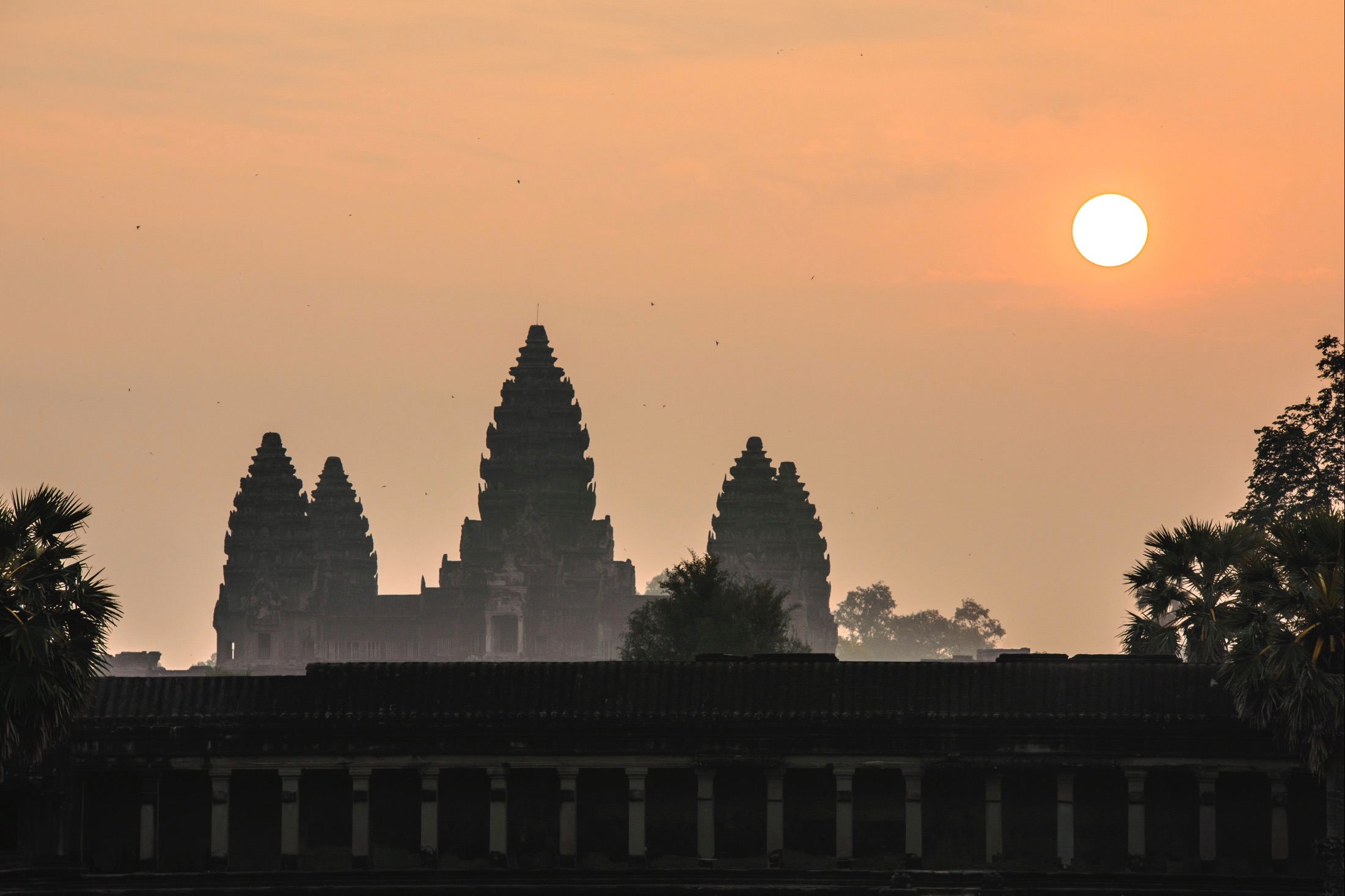
Some places live up to the hype. Angkor Wat blows past it. Rising from the forest just north of Siem Reap, this 12th-century temple is widely considered the largest religious monument on Earth — five lotus-bud towers, a moat that looks like a lake, and galleries covered in carved gods, demons, warriors, and dancers. It’s a UNESCO World Heritage Site, it’s on Cambodia's flag, and people have worshipped here for almost nine centuries.
Here’s the twist: it’s only the opening act. Angkor Wat sits inside the Angkor Archaeological Park, a 400 sq km (155 sq mi) sprawl of forest and rice fields, dotted with moats, dozens of temples, and the remains of the great Khmer capitals. Here’s what to expect, and how to make the most of your visit:
In the early 12th century, King Suryavarman II set out to build the grandest temple the Khmer Empire had ever seen. He dedicated it to the Hindu god Vishnu, the preserver of the universe, and designed it as a map of the cosmos. The central tower stands for Mount Meru, the mythical home of the gods, and the surrounding moat stands for the ocean at the edge of the world. To reach the temple, you cross that moat on a long stone causeway lined with nagas, hooded serpents. They’re water spirits, and Khmer legend says the Khmer people descend from a naga princess, so these snakes are ancestors as much as guards.
The engineering is as extraordinary as the symbolism. Builders carved the temple from sandstone, much of it quarried in the Kulen hills to the northeast, then moved it to the site and stacked it into towers. Water got the same ambitious treatment. Khmer engineers dug canals, raised dikes, and built giant reservoirs called barays. The biggest, the West Baray, is about 8km long and 2km wide, and it can hold roughly 53 million cubic metres. Its western end still holds water year-round, though the other large barays have dried out.
Suryavarman II never saw it finished, and never knew his temple to Vishnu would one day become a Buddhist place of worship. He also left behind one big question: why does Angkor Wat face west? Most Angkor temples face east, toward the sunrise, and west is the direction linked with death. The carved galleries add to the riddle. Hindu worshippers normally circle a shrine clockwise, but these reliefs run counterclockwise, the way funeral rites go. Many historians take that as a sign Suryavarman II planned the temple as his tomb as well as Vishnu’s home, though he was never buried there. Others point out that west is also Vishnu's direction, so the layout may simply honour the god. Nobody can prove either theory, so decide for yourself as you walk the galleries.
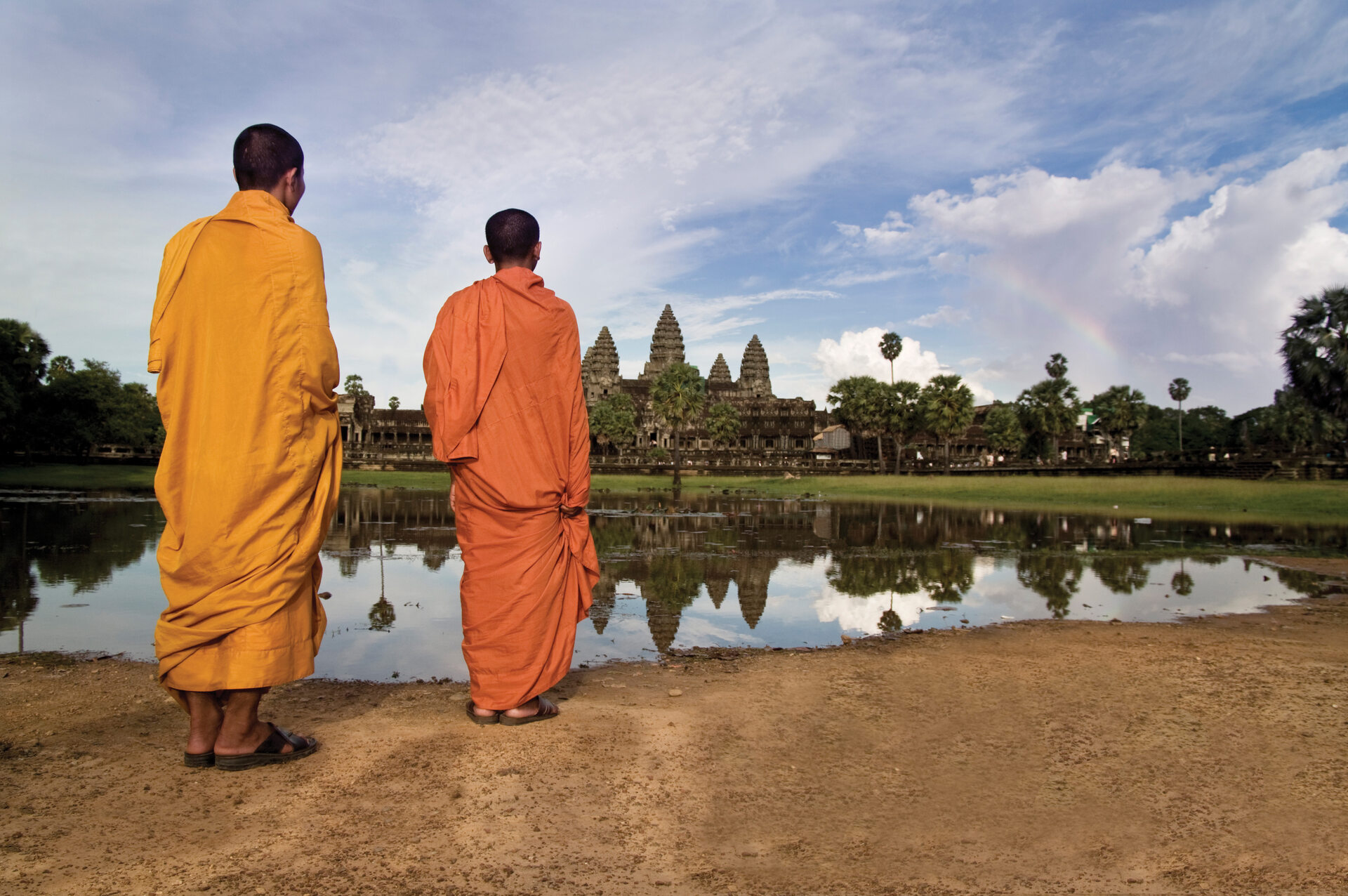
Whatever Suryavarman II intended, Angkor Wat has had a long second life. When the Khmer court moved south in the 15th century, forest crept over much of the old city, yet Buddhist monks kept this temple in use. In the 1860s, French naturalist Henri Mouhot's account drew wide attention in Europe, although Khmer people had never lost the site. War in the 1970s did serious damage, and UNESCO's 1992 listing brought international help to repair it. Today, it’s still a working temple: a place of worship first, and a sight second.
Angkor is best explored with your eyes open and your pace unhurried. From intricate carvings and towering stone faces to temples slowly being reclaimed by the jungle, each site has its own character and stories to uncover. Here are the highlights to look out for:
Angkor Wat has three levels, each rising towards the central sanctuary. The outer galleries are lined with around 800m (2,625 ft) of bas-reliefs depicting Hindu mythology, Khmer battles, royal processions and scenes of heaven and hell.Among the most celebrated is the Churning of the Ocean of Milk, depicting gods and demons locked in a cosmic tug-of-war, pulling on a giant serpent to churn the ocean and release the nectar of immortality.
Higher up, more than 1,800 carved celestial figures adorn the sandstone walls, while steep stairways lead to the Bakan, the temple’s highest level. The climb up mirrors the hard road to the kingdom of the gods, and your thighs will agree. At the summit, standing Buddha images in the walls of the central sanctuary reflect the temple’s gradual transition from Hindu to Buddhist worship.
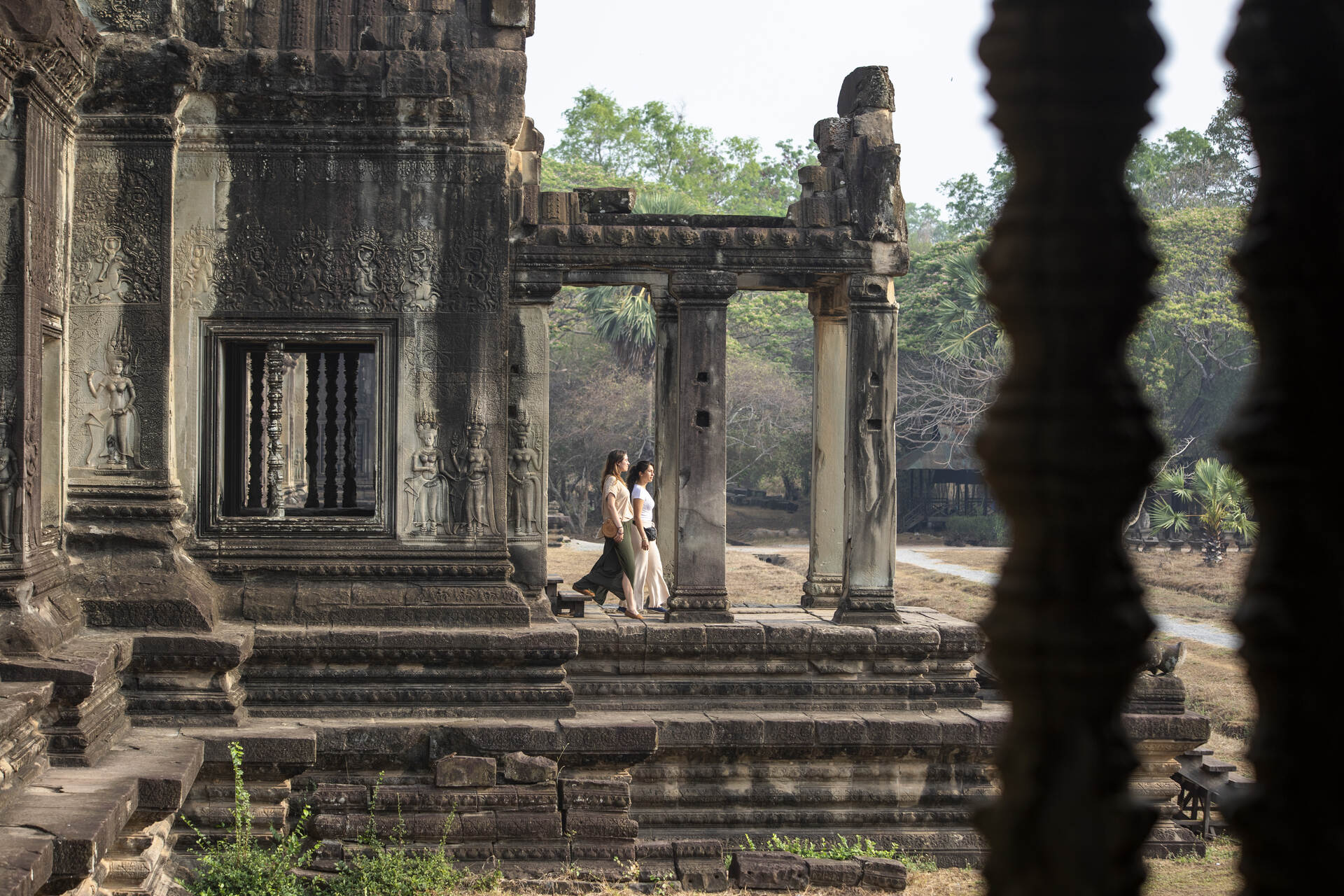
Angkor Wat gets the applause, but the supporting cast earns its ticket. Here they are in all their glory:
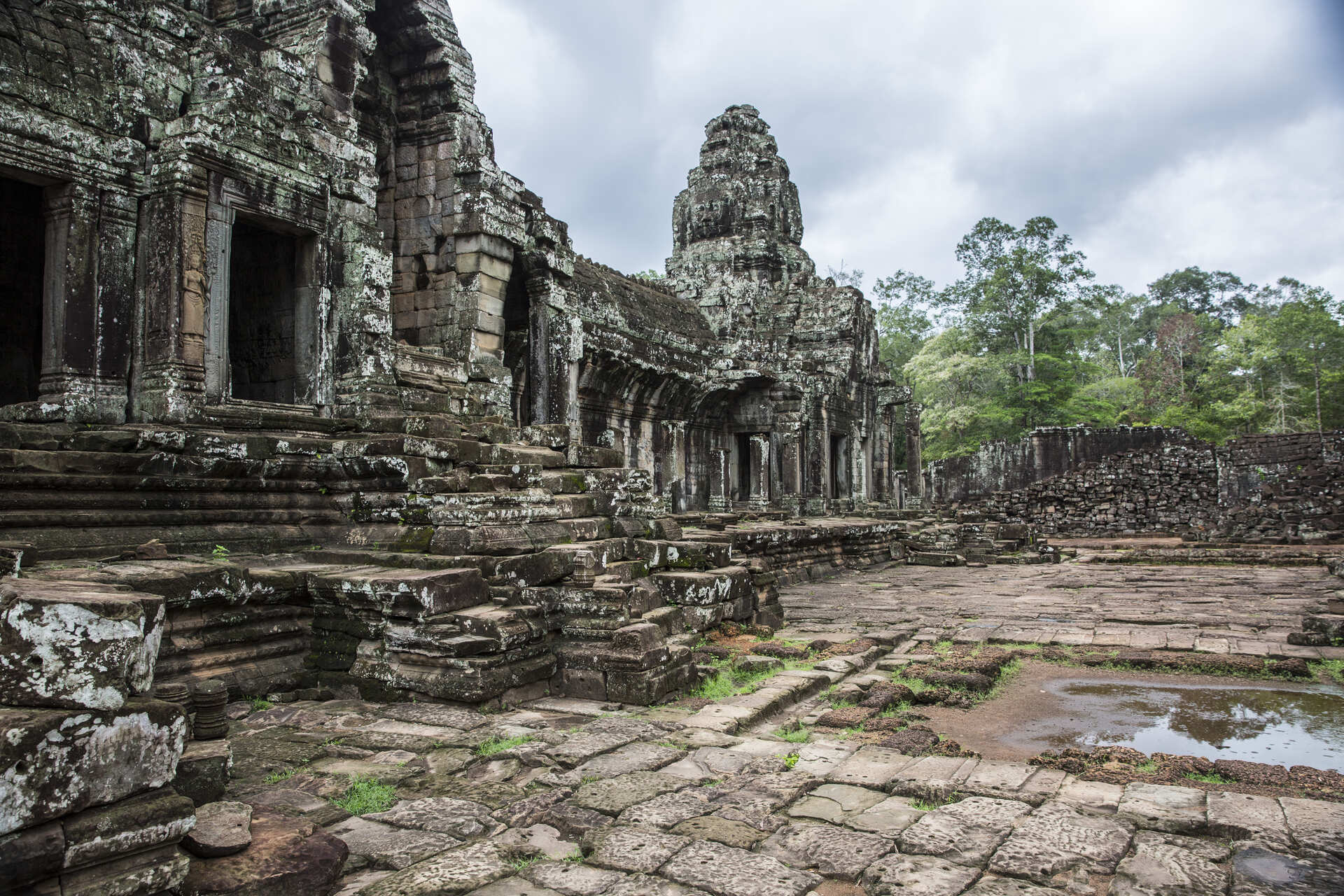
Angkor Thom and the Bayon: Just north of Angkor Wat, King Jayavarman VII established Angkor Thom in the late 12th century and became the last great capital of the Khmer Empire. Stone gods and demons line its entrance bridges, hauling on a giant serpent in a scene from the same myth depicted at Angkor Wat. At the heart of this walled city stands the Bayon temple, its towers are carved with more than 200 giant smiling faces, usually read as Avalokiteshvara, the Buddhist bodhisattva of compassion.
Terrace of the Elephants: Just north of the Bayon, this 350m (1,150 ft) platform was the king’s viewing stand for returning armies and royal ceremonies. Life-size stone elephants march along its wall. Nearby, the Terrace of the Leper King, with its intricate tiers of carved figures, rewards a closer look.
Ta Prohm: This is the temple where nature steals the show. Giant tree roots twist over ancient walls and spill across crumbling stone corridors, making Ta Prohm one of Angkor’s most memorable sights. You might recognise it from Lara Croft: Tomb Raider, filmed here in 2000. Look for a carving that some say resembles a stegosaurus (dinosaur), while others believe it shows a rhino among leaves. Keep an eye out and see what you make of it.
Preah Khan: One of Angkor’s largest temple complexes, Preah Khan has a maze of corridors, detailed carvings of sages and celestial dancers, and lichen-covered stonework. It has a similar overgrown feel to Ta Prohm but often fewer visitors, so you get more room to explore its hidden corners.
Neak Poan: Set on a small island in the middle of a reservoir, this temple is reached by a wooden walkway across the water. Built around a central pool with four smaller pools, it was once associated with ritual healing and purification. Water levels change with the seasons, but it’s a peaceful change of pace from the bigger complexes. Just east, Ta Som is small but worth a stop for its eastern gate, where a fig tree’s roots engulf the stonework, making for a great photo opportunity.
Pre Rup: For sweeping views across the countryside, climb this 10th-century temple, built as a stepped pyramid and crowned with five brick towers. Visit at sunset, when the warm light brings out the rich colours of the brickwork
Banteay Srei: About 25km (16 mi) from the main group, this 10th-century Hindu temple is small but rich in detail. Built from pink sandstone, it’s one of Angkor’s finest examples of stone carving, with towers and library pediments covered in reliefs of Hindu deities and scenes from the epic Ramayana.
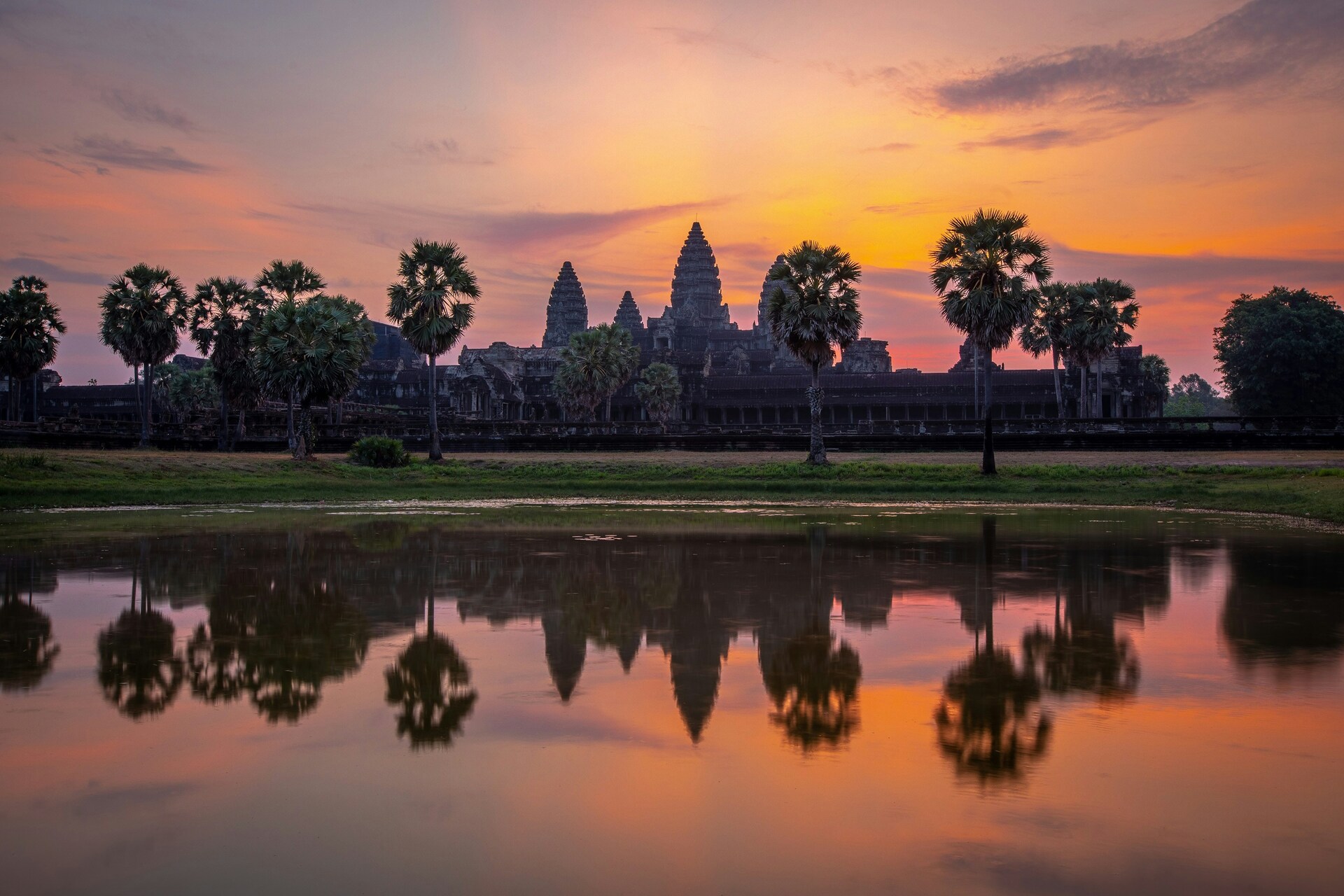
November to February is your best bet: dry, clear and around 21°C to 30°C. March to May is scorching. May to October brings afternoon downpours, green jungle, mirror-still moats, and thinner crowds.
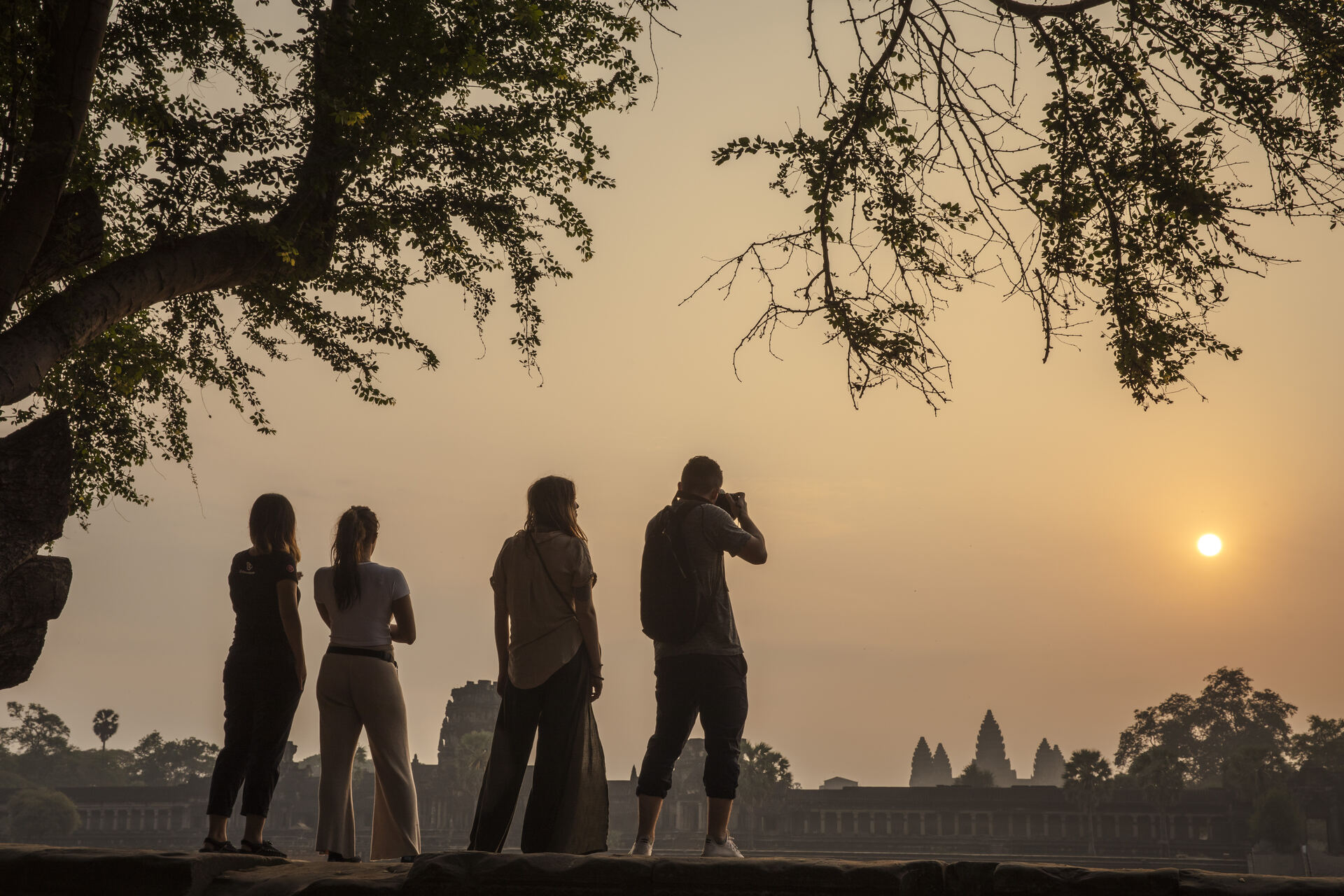
Time of day matters as much as the season.The park opens at 5am, and first light arrives around 5:30am to 6am. To dodge the sunrise crowds, slip in through the east entrance, watch the sun climb, then head out the west gate for coffee. After that, if you can brave the heat, save the busiest temples, like Ta Prohm and the Bayon, for lunchtime, when crowds often ease.
Fly into Siem Reap Angkor International Airport, about 45km (28 mi) from town. Budget an hour for the transfer. A shuttle bus costs about $8 (CAD 8), and a taxi runs about $35 (CAD 50).
Once you're in Siem Reap, you're only 6km (4 mi) from Angkor Wat, and you’ve got options. A tuk-tuk and driver for the day costs around $20 (CAD 29) to $25 (CAD 35), a scooter about $10 (CAD 14) to $15 (CAD21), and a bicycle about $3 (CAD4) to $5 (CAD7). Agree on the route and price before you set off. Pedalling works well in cooler months, and a cycling path links town to the temples.
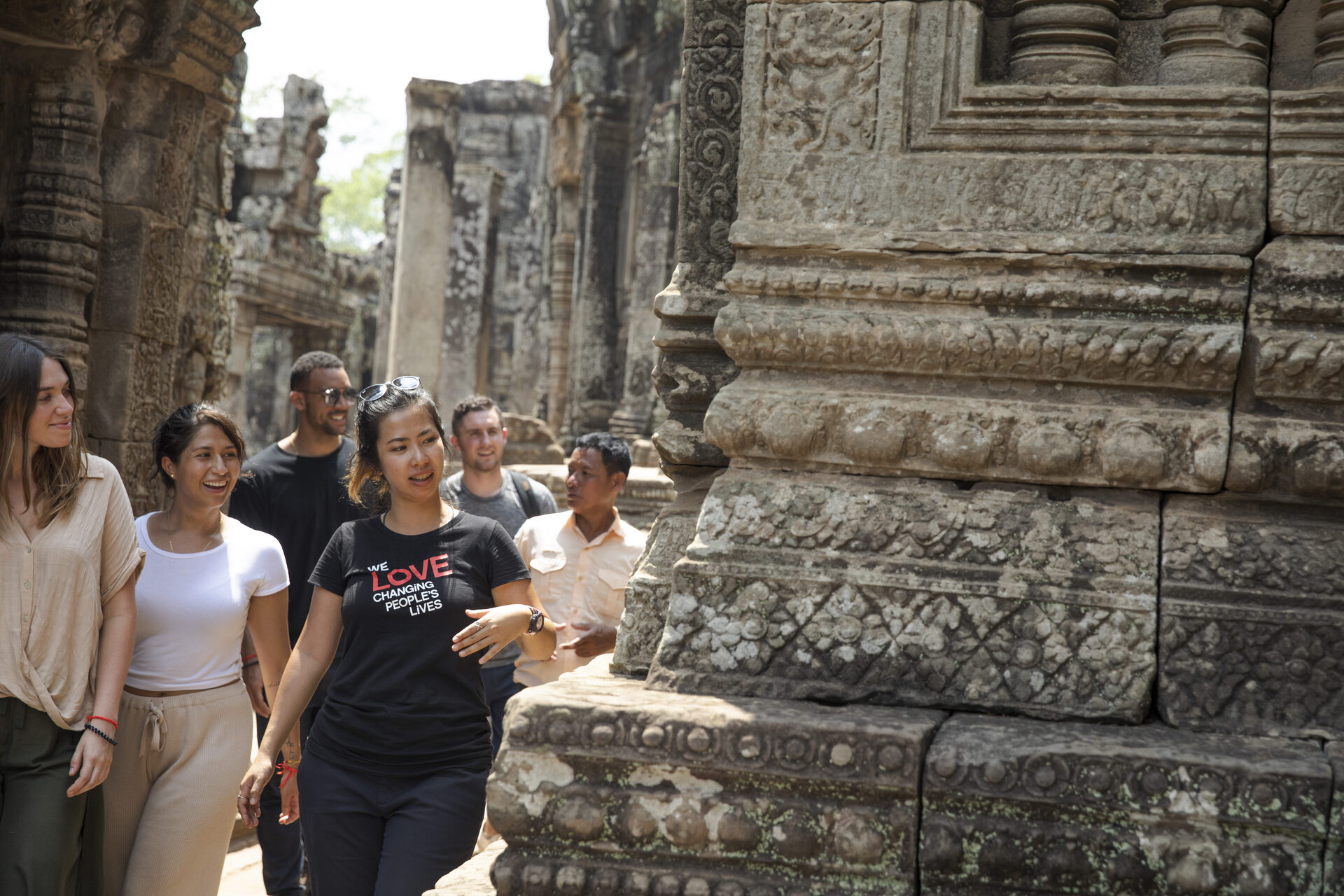
Whichever way you roll, add a licensed guide, which can be arranged from your hotel or at the site itself. Or skip the legwork: we’d recommend booking the Ancient Angkor Wat Independent Adventure, which includes local guides who’ll decode the carvings. That's money well spent.
Want a bird’s-eye view? A tethered helium balloon near Angkor Wat rises about 120m (394 ft) for a 10 to 15 minute ride, for roughly $20 (CAD29) to CAD42. It only flies in good weather, and it doesn’t need a temple pass.
One pass covers the whole park. It’s $37 (CAD 53) for one day, $62 (CAD 88) for three days (use them within seven days), and $72 (CAD 103) for seven days (use them within a month). Kids under 12 get in free. Buy online through Angkor Enterprise, the official operator, or at the ticket office. Here’s a handy trick: tickets bought after 5pm are valid from the next morning, but they let you in that evening, which is perfect for sunset.
One day covers the highlights, but it can feel hot, hurried and over before you’ve had time to take it all in. If that’s all you have, follow the Small Circuit: Angkor Wat at sunrise, the Bayon by late morning and Ta Prohm in the afternoon. Allow three days to explore at a more leisurely pace, taking in the Grand Circuit’s temples, including Preah Khan, Neak Poan and Pre Rup, plus a half-day trip to Banteay Srei.
Cover your shoulders and knees. Lightweight trousers or a long skirt are your best bet, along with a hat and sturdy shoes for the steep, uneven steps. Carry plenty of water to stay hydrated in the heat. Respect the temples: don’t touch carvings, sit or climb on the structures, and keep a respectful distance from monks.